Table of Contents:
- What Makes a Brown Mini Goldendoodle Different
- Size, Shades, and What to Expect as They Grow
- Pattern Options: More Than Just Solid Brown
- F1B: Your Best Bet for Consistent Brown Color
- Brown Mini Goldendoodle Temperament
- Health Testing for Brown Mini Goldendoodles
- Brown Mini Goldendoodle Puppies: The First 8 Weeks
- Grooming Your Brown Mini Goldendoodle
- Frequently Asked Questions
The brown Mini Goldendoodle stands out with a warm chocolate coat that ranges from soft caramel to deep espresso. This coloring requires both parents to carry a specific recessive gene inherited from the Poodle side. Only 15 to 25% of litters produce this shade, making it genuinely less common than cream or apricot. If you’re drawn to a light brown Mini Goldendoodle with milky mocha tones or a rich dark chocolate look, this guide explains the genetics, what changes as your puppy matures, and how to find a quality breeder.
What Makes a Brown Mini Goldendoodle Different
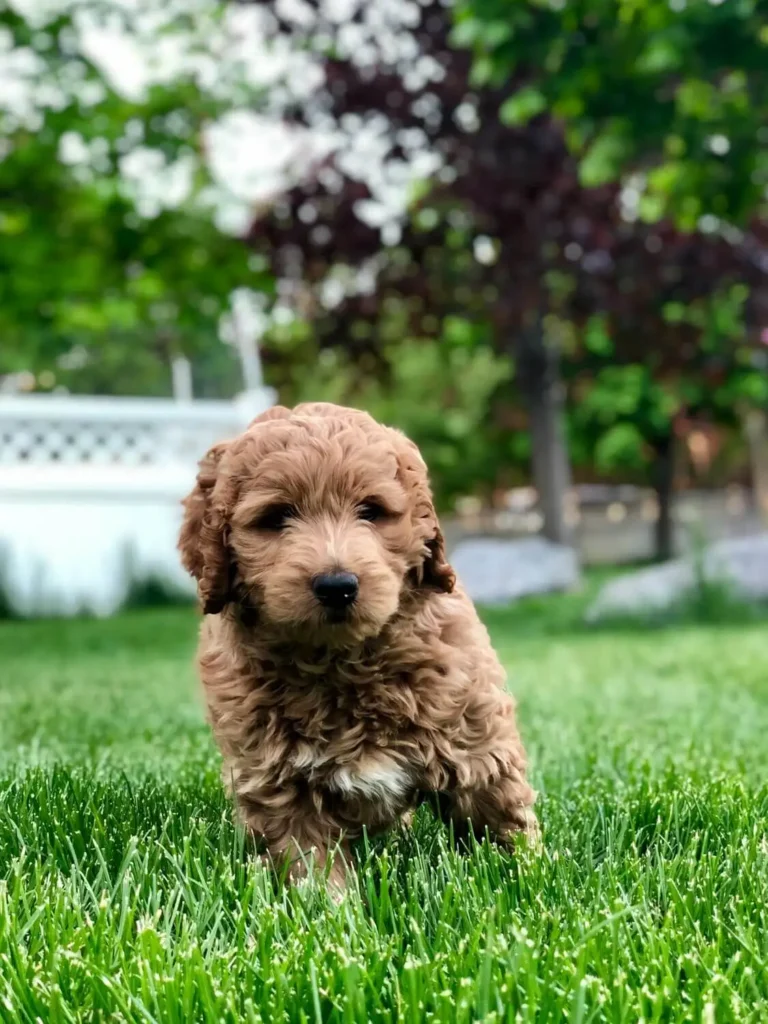
A brown Mini Goldendoodle gets its chocolate color from two copies of a recessive gene called bb, one inherited from each parent. What sets a true chocolate dog apart isn’t just the coat color: these dogs also have brown noses, brown eye rims, and brown paw pads instead of black. That full-body pigment shift is the clearest way to confirm you’re looking at a genetically brown dog rather than a dark apricot or faded red.
How the Brown Gene Works
The brown gene (technically the B Locus, or TYRP1) converts black eumelanin pigment to brown throughout the hair follicles and skin. According to the UC Davis Veterinary Genetics Laboratory, five different variants of this gene have been identified in dogs, and two copies of the recessive allele (b/b) are required to produce the chocolate phenotype. The exact shade within the brown spectrum is controlled by additional modifier genes that determine pigment density per hair shaft.
Most brown Mini Goldendoodle puppies start noticeably dark and lighten over the first 6 to 14 months as adult coat grows in. The ear color at 8 weeks is the most reliable early predictor of adult shade. Ears tend to hold close to their original tone while body coat fades by one or two shades.
Brown Compared to Other Warm Colors
Brown and apricot may both read as warm tones in photos, but they come from entirely different genetic pathways. The easiest distinction: brown Mini Goldendoodles always have brown noses, while apricot and red dogs have black noses regardless of coat shade. Red Goldendoodles show a bright, orange-influenced tone similar to Irish Setters. Apricot has softer peachy undertones. Brown brings an earthy, muted chocolate depth that photographs with natural dimension and reads as sophisticated rather than flashy.
| Feature | Brown | Apricot | Red |
|---|---|---|---|
| Nose color | Brown | Black | Black |
| Eye rims | Brown | Black | Black |
| Paw pads | Brown | Black | Black |
| Gene type | Recessive bb | Phaeomelanin | Phaeomelanin |
| Rarity in litters | 15–25% | Common | Less common |
| Shade variation | Caramel to espresso | Peach to gold | Copper to deep auburn |
Size, Shades, and What to Expect as They Grow
Mini Goldendoodles typically weigh between 15 and 35 pounds fully grown and stand 13 to 20 inches at the shoulder. Males tend to land at 20 to 35 pounds; females usually range 15 to 30 pounds. The chocolate coat reaches its richest, most settled color between 12 and 18 months, when the adult coat is fully established.
The Brown Spectrum: Light, Medium, and Dark
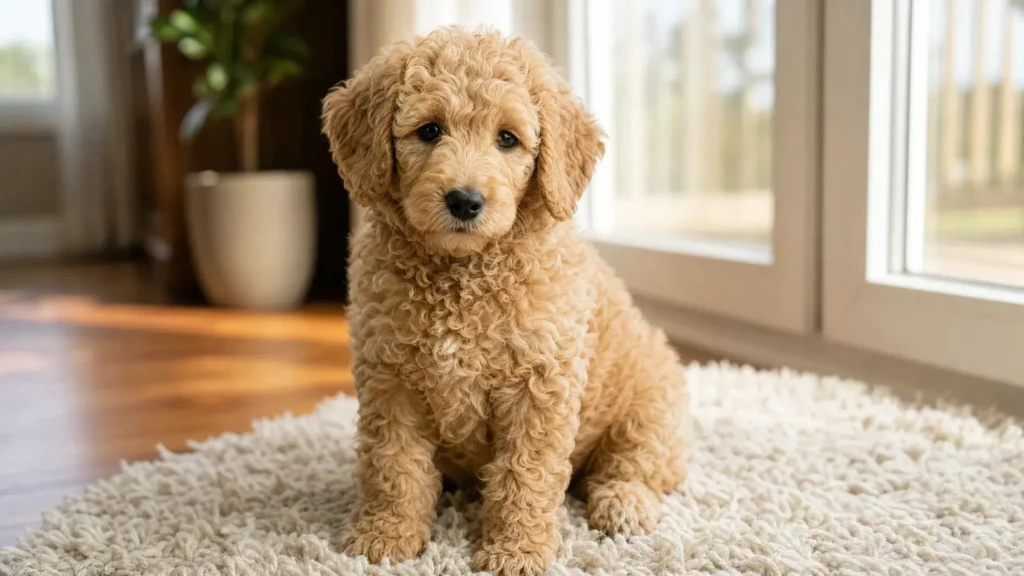
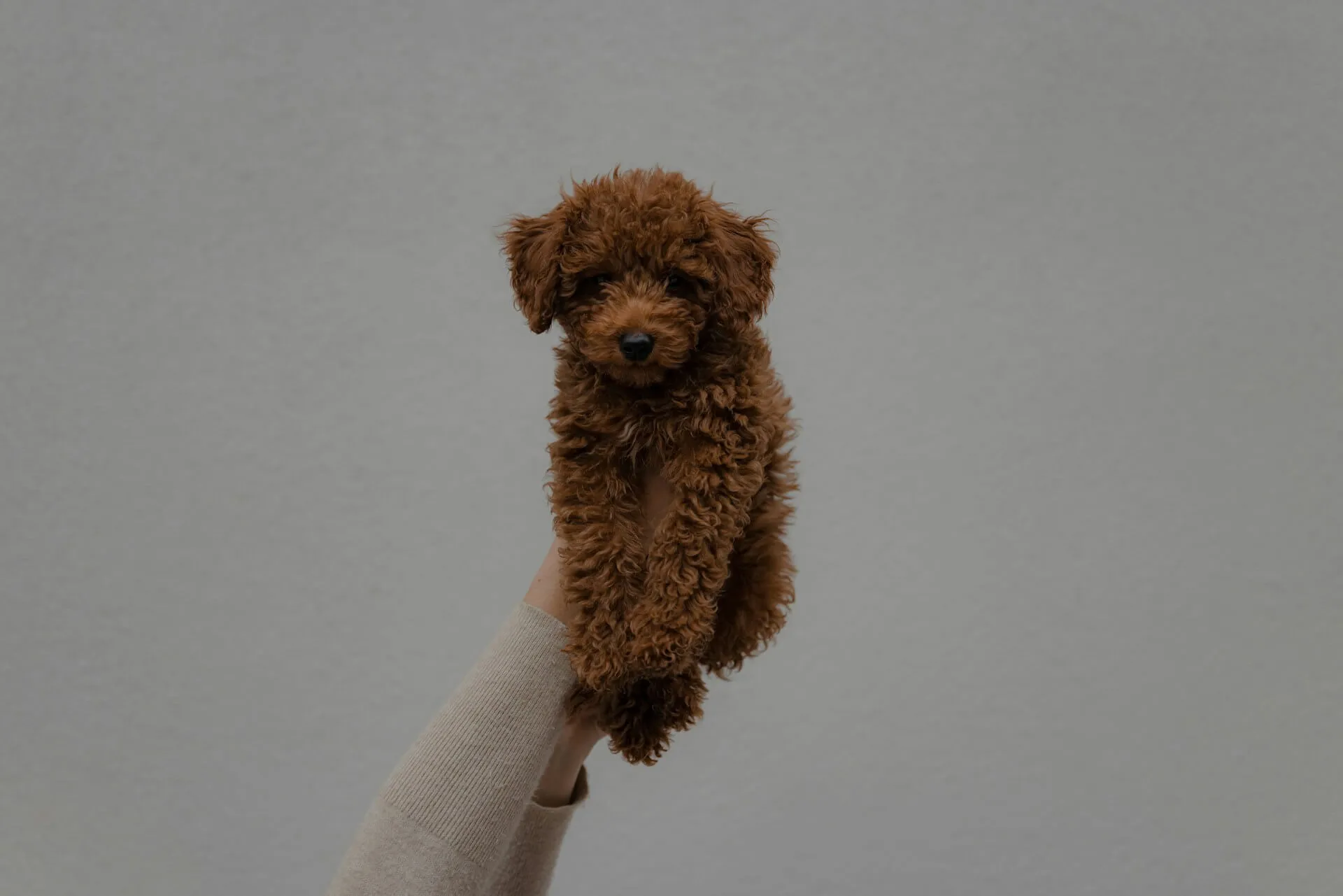
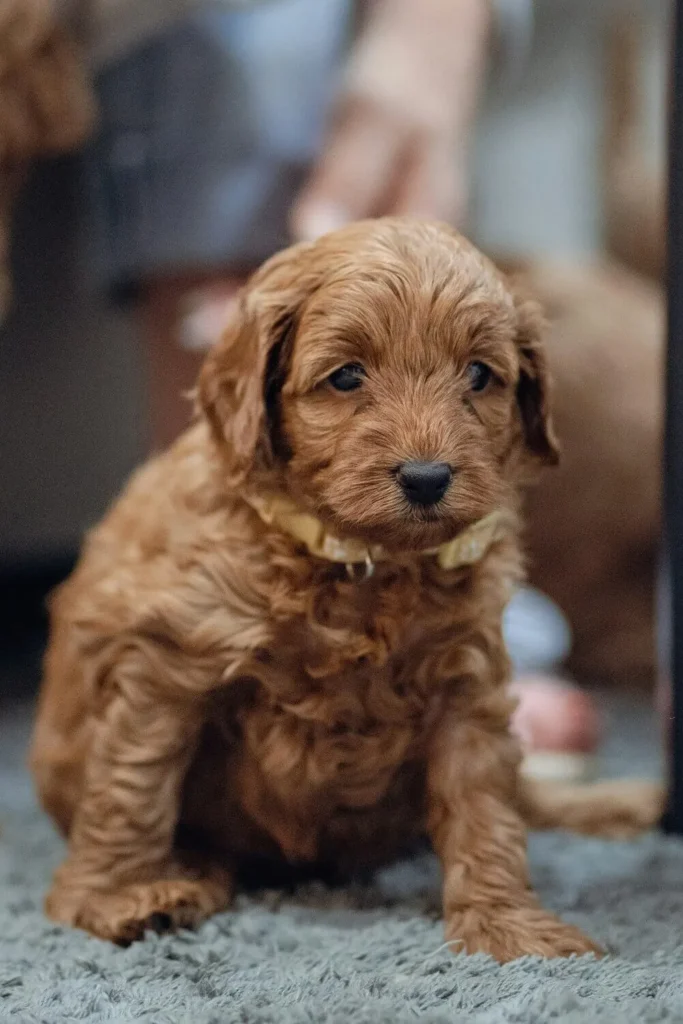
The light brown Mini Goldendoodle shows warm milk chocolate or caramel tones, often with slightly lighter coloring on the legs and chest. Medium brown hits the classic Hershey’s chocolate range that most families picture when they search for a chocolate doodle. The dark brown Mini Goldendoodle carries the deepest, most saturated espresso color. It can appear nearly black indoors but reveals its true chocolate warmth in natural light. Even on solid-colored dogs, the ears are typically one to two shades deeper than the body, creating natural visual dimension without any pattern.
Will the Color Change Over Time?
Yes, and the change is consistent across nearly all brown Mini Goldendoodles. The puppy coat lightens by one to two shades between 6 and 14 months as adult fur replaces it. This shift typically stabilizes by 18 months, after which the color stays consistent for life. Factors that accelerate fading include excessive sun exposure, low-quality nutrition, and harsh or stripping shampoos. A balanced diet with adequate omega-3 fatty acids and grooming with a color-appropriate shampoo helps maintain maximum richness over time.
Pattern Options: More Than Just Solid Brown
Solid brown makes up approximately 60 to 70% of brown Mini Goldendoodle litters, but several pattern combinations also appear. Knowing these options helps set expectations when you’re choosing between puppies in a litter.
Brown pattern types:
- Solid brown. The most common pattern, with consistent chocolate pigment from root to tip across the entire coat. Ears are usually the darkest section, creating subtle natural shading that looks particularly striking in curly-coated dogs.
- Parti (white and brown). Defined as 50% or more white combined with brown patches. The distribution is highly variable. Some parti dogs are mostly chocolate with a white chest and blaze, while others are predominantly white with scattered brown patches.
- Tuxedo. A precise parti pattern where white appears specifically on the chest, all four paws, the muzzle, and the tail tip. The formal-wear analogy is accurate: these dogs look dressed for an event.
- Abstract. Less than 50% white with placement that follows no predictable rule. It could be a white chest stripe, a single white paw, or random patches on the torso. No two abstract dogs look exactly alike.
- Phantom. Brown as the base color with tan or lighter markings above the eyes, on the muzzle, chest, legs, and under the tail. The pattern mirrors Doberman or Rottweiler coloring and is the rarest combination in brown Mini Goldendoodle litters.
White and Brown vs. Black and Brown
White and brown Mini Goldendoodle combinations create the highest visual contrast and tend to photograph with exceptional clarity. Dirt hides better on these dogs than on solid white doodles, while the combination remains more visually interesting than solid brown. Black and brown patterns (typically phantom) require the dog to carry both a brown gene pair and specific agouti patterning. This genetic combination is uncommon and typically commands a higher price from breeders who specialize in it.
F1B: Your Best Bet for Consistent Brown Color
The F1B Mini Goldendoodle (75% Poodle, 25% Golden Retriever) produces the most predictable chocolate coat of any generation. When both the Poodle parent and the F1 parent carry confirmed bb genetics, approximately 85% of the resulting litter will be chocolate.
F1 browns (50/50 split) vary more in both coat texture and color depth because the Golden Retriever contribution is higher. For families specifically seeking the chocolate shade, F1B or later multigenerational pairings give breeders far more control over the outcome.
Why F1B Works Best for Brown
Breeding an F1 Goldendoodle back to a Miniature Poodle concentrates the bb gene in the offspring while increasing Poodle genetics to 75%. The practical result is a curlier, lower-shedding coat better suited for allergy-sensitive households, plus a much higher likelihood of chocolate coloring across the litter.
| Generation | Poodle % | Brown Prediction Rate | Coat Type |
|---|---|---|---|
| F1 | 50% | 25–40% | Wavy to curly |
| F1B | 75% | Up to 85% | Curly |
| Multigen | Varies | 85–95%+ (if both parents confirmed bb) | Curly |
Brown Mini Goldendoodle Temperament
Coat color has no influence on personality. A brown Mini Goldendoodle carries the same temperament characteristics as any other color. What matters is the genetic contribution from both parent breeds, the quality of early socialization, and the individual puppy’s inherited disposition from the specific sire and dam.
The Miniature Poodle side contributes high intelligence and strong trainability. According to the American Kennel Club, Poodles are active, eager to please, and deeply attentive to their owners. Those traits carry directly into Goldendoodle offspring. The Golden Retriever side adds patience, warmth, and a natural gentleness that makes Mini Goldendoodle dogs reliably good with children and other pets.
What to Expect Day-to-Day
- Trainability. These dogs pick up basic obedience commands quickly. Most owners establish sit, stay, and come within the first two weeks of consistent short training sessions (5 to 10 minutes, two to three times daily). The same Poodle intelligence that makes learning easy also means boredom sets in fast without mental stimulation.
- Social needs. Brown Mini Goldendoodles are people-oriented and form strong attachments. Separation anxiety is a documented tendency across the breed, not tied to any specific color. Structured crate training starting at 8 weeks is the most effective prevention strategy. It teaches independence gradually rather than requiring the dog to manage long alone periods without preparation.
- Energy level. Daily exercise of 30 to 45 minutes covers most adult dogs comfortably. Puppies under 12 months need shorter, more frequent sessions to protect developing joints. Fetch, off-leash time in a fenced yard, and puzzle feeders address both physical and mental needs.
- Family compatibility. These dogs adapt well to apartments, houses with yards, single-person households, and families with children. Their size (15 to 35 pounds) makes them sturdy enough for active play without being large enough to knock over small children.
Health Testing for Brown Mini Goldendoodles
Responsible breeding goes beyond color genetics. Before committing to a brown Mini Goldendoodle puppy, knowing which health screenings reputable breeders run on their dogs helps you evaluate breeders with confidence.
Why Chocolate Lines Need an Extra DNA Test
The same Miniature Poodle bloodlines that reliably produce brown coloring carry a statistically higher incidence of Progressive Retinal Atrophy (PRA), a heritable eye condition that can lead to progressive vision loss. PRA does not mean your puppy will go blind. It means the parent dogs should have a DNA test confirming they don’t carry the affected allele before being bred. This is a simple cheek-swab test that any responsible breeder running a chocolate program should be able to document.
The standard for eye health clearances in breeding dogs is the OFA Companion Animal Eye Registry (CAER), administered by the Orthopedic Foundation for Animals. Board-certified veterinary ophthalmologists conduct the examination, and all normal results are publicly searchable in the OFA database. Always request the CAER certification numbers for both parent dogs before placing a deposit on any puppy.
Full Health Testing Checklist
A breeder running a quality Mini Goldendoodle program should provide documentation for all of the following on the parent dogs:
- OFA hip evaluation. Assesses joint structure for hip dysplasia risk. Dogs must be at least 24 months old at the time of evaluation to receive a formal certification number. A “preliminary” hip evaluation on a younger dog is not a substitute.
- OFA cardiac clearance. Performed by a board-certified cardiologist, this screens for structural heart defects. Subvalvular aortic stenosis (SAS) is a condition with documented incidence in Golden Retrievers and can pass to offspring.
- PRA-prcd DNA test. A genetic test that identifies carriers of the most common Progressive Retinal Atrophy variant in Poodles. This test is age-independent and can be performed on dogs of any age, including before first breeding.
- OFA elbow and patellar clearances. Relevant for Mini-sized dogs, patellar luxation (kneecap displacement) is the most common orthopedic issue in smaller Goldendoodles.
If a breeder cannot provide OFA numbers for at least hips, eyes, and cardiac on the parent dogs, that is a meaningful gap regardless of how appealing the puppies look in photos.
Brown Mini Goldendoodle Puppies: The First 8 Weeks
Mini Goldendoodle puppies are frequently born darker than their adult coat will be. Newborns can appear very deep chocolate or nearly black at birth, with the recognizable chocolate tone developing clearly within the first two to three weeks. By 8 weeks, the standard release age, you can assess the shade range accurately and get a reliable read on which end of the brown spectrum your puppy will likely settle into.
Developmental Milestones for Brown Puppies
Understanding what happens during the first 8 weeks helps you evaluate whether a breeder’s program gives puppies the start they need:
- Weeks 1–2 (neonatal stage). Eyes and ears remain closed at birth. Puppies depend entirely on their mother for warmth and nutrition. Eyes typically begin to open between days 10 and 14; ears follow shortly after. Coat color is visible but unstable. Puppies in this stage may look darker or lighter than they’ll appear at 8 weeks.
- Weeks 3–4 (transition stage). By week three, puppies begin exploring beyond the whelping box as vision and hearing develop. Brief, gentle handling by the breeder during this window, with exposure to different textures, mild sounds, and calm human contact, has documented positive effects on confidence and trainability.
- Weeks 5–7 (socialization stage). This falls within the primary socialization window (3–14 weeks), one of the most important developmental periods in a dog’s life. Exposure to varied environments, sounds, people, and other animals during this period shapes the dog’s social identity. A breeder who keeps puppies isolated during weeks 5 to 7 is creating future behavior problems regardless of genetic quality.
- Week 8 (readiness). Most Mini Goldendoodle puppies are ready to go home at 8 weeks. This aligns with both the developmental minimum and the legal standard in most U.S. states. Puppies taken home before 7.5 weeks miss critical bite inhibition and social learning from their mother and littermates.
Signs of a Healthy Brown Puppy at 8 Weeks
When evaluating brown puppies in person, look for these specific indicators:
- Brown nose, brown eye rims. Both confirm the bb genotype is expressing correctly. A black nose on a dog marketed as chocolate is a genetic mismatch.
- Clear, discharge-free eyes. Some mild tearing is normal; significant discharge or crusting is not.
- Engaged, curious behavior. A healthy 8-week-old puppy should approach visitors with interest. Hiding, cowering, or refusing to engage suggests undersocialization.
- Round but not distended belly. A hard, bloated midsection can indicate parasites. A flat, tight belly may indicate malnutrition.
- Clean coat without musty odor. Mini Goldendoodle puppies naturally have a faint warm scent. An ammonia or fermentation smell signals poor sanitation in the whelping environment.
Grooming Your Brown Mini Goldendoodle
Mini Goldendoodles need consistent grooming to maintain coat health and prevent matting. The practical advantage of the chocolate coat is that brown hides dirt far better than cream or white, so your dog can go longer between baths without looking visibly soiled. The downside is that tear staining shows more clearly against brown fur than it would on an apricot.
Daily and Weekly Care
Brush your Mini Goldendoodle 3 to 4 times per week as a baseline, or daily if the coat is very curly. The areas most prone to matting — behind the ears, under the armpits, the collar line, and where the legs meet the body — need specific attention at every session. Work through with a slicker brush first, then follow with a metal comb to catch any hidden tangles that the slicker missed.
Bathing every 4 to 6 weeks using a gentle dog-safe shampoo is sufficient for most Mini Goldendoodles. Some owners use a color-enhancing shampoo formulated for brown or chocolate coats, which can temporarily deepen the tone by removing product buildup. Always brush before bathing. Water causes existing tangles to tighten and lock, making post-bath detangling significantly harder.
Professional Grooming Schedule
Plan for a professional grooming appointment every 6 to 8 weeks. A groomer familiar with Goldendoodle and Poodle-mix coats will handle the full-body trim, nail trim, ear cleaning, and any stubborn matting. Brown coats specifically benefit from groomers who know that incorrect blade selection can leave the coat looking patchy or faded. That problem shows up more on brown than on lighter colors.
Tear Stain Management
Dark fur makes tear stains more obvious, not because Mini Goldendoodles are more prone to staining than lighter dogs, but because the contrast between the reddish-brown stain and the chocolate coat is clearly visible. Daily gentle wiping around the eyes with a damp cloth prevents buildup. If staining persists despite regular cleaning, talk to your vet. Underlying causes include eye anatomy, water mineral content, and diet, all of which can be addressed directly.
Coat Care Comparison by Color
| Coat Color | Dirt Visibility | Tear Stain Visibility | Sun Fading Risk | Special Products Needed |
|---|---|---|---|---|
| Brown | Low | Medium–High | Medium | Color-enhancing shampoo optional |
| Cream/White | Very High | Very High | Low | Whitening shampoo recommended |
| Apricot | Medium | Medium | Low | Standard shampoo sufficient |
| Red | Low | Low | Medium–High | UV-protective coat spray helpful |
Finding Your Brown Mini Goldendoodle
Both parents must carry two copies of the bb gene for brown Mini Goldendoodle puppies to appear consistently. This genetic requirement limits which dogs can be paired together, so dedicated chocolate programs are smaller and less common than programs producing cream or apricot. Many breeders default to easier-to-predict colors, so finding a quality source for puppies typically takes more research and often involves a waitlist.
At Love of Puppies in Sullivan, Illinois, we focus on Mini Goldendoodles with careful attention to genetics, health, and temperament.
Frequently Asked Questions
Do brown Mini Goldendoodles shed less than other colors?
No. Shedding is determined by coat type and generation, not color. An F1B Mini Goldendoodle with a curly coat will shed minimally, while an F1 with a wavy coat may shed moderately. The same pattern applies to cream or apricot dogs of the same generation.
Will my brown puppy’s coat get lighter?
Yes, in almost every case. Brown puppies lighten by one to two shades between 6 and 14 months as adult coat replaces puppy fur. Check the ear color at 8 weeks. It’s the most reliable early indicator of the adult shade range.
Are brown Mini Goldendoodles good with kids?
Yes. Only 15 to 25% of Goldendoodle litters produce puppies because both parents must carry confirmed bb genetics. This limits the number of breeders who can reliably produce chocolate litters, which is why waitlists are common.
How much grooming do they need?
Brush 3 to 4 times weekly and get professional grooming every 6 to 8 weeks.
What’s the difference between light and dark brown?
From a health-tested, reputable breeder, expect $2,000 to $3,500. The premium over cream or apricot reflects the smaller number of breeders running dedicated chocolate programs and the genetic complexity of producing brown Mini Goldendoodle litters consistently. Prices significantly below $1,500 are a strong indicator of missing health testing or poor breeding conditions.