Table of Contents:
- How Much to Feed a Mini Goldendoodle Puppy by Age
- Feeding Frequency and Daily Schedule
- Choosing the Right Food Type and Formula
- Weight Management and Body Condition
- Treats and Food Transitions
- Cost and When to Get Professional Guidance
- Frequently Asked Questions
- FAQ
A Mini Goldendoodle puppy needs 1 to 2.5 cups of food a day depending on age and weight, split into 2 to 4 meals, with amounts dropping slightly once growth slows around 12 months. Mini goldendoodle feeding isn’t one-size-fits-all, since a 6-pound puppy and a 30-pound near-adult have very different calorie needs. This guide breaks the numbers down by age and weight, then covers meal timing, food type, and how to tell if you’re feeding the right amount.
How Much to Feed a Mini Goldendoodle Puppy by Age
The right amount depends on your puppy’s current weight and age, not a single fixed number that applies at every stage. As a Mini Goldendoodle grows from a 6-pound puppy toward a 25 to 40-pound adult, both portion size and meal frequency shift, sometimes within the same month if a growth spurt hits. The chart below gives a starting point based on kibble with roughly 350 to 400 calories per cup, the density of most standard puppy formulas, so treat it as a baseline rather than the final word.
Cross-checking against your specific bag matters more than most owners assume. Two kibbles marketed as “puppy formula” can differ by 50 calories or more per cup, which adds up fast over a week of feeding.
Mini Goldendoodle Feeding Chart by Age and Weight
Here’s the mini goldendoodle feeding chart by age most owners can use as a baseline, then adjust from there.
| Age | Approximate Weight | Meals per Day | Daily Food Amount |
| 8 to 12 weeks | 5 to 10 lbs | 3 to 4 | 1 to 1.5 cups |
| 3 to 6 months | 10 to 20 lbs | 3 | 1.5 to 2 cups |
| 6 to 12 months | 20 to 30 lbs | 2 | 1.5 to 2.5 cups |
| 12 months and older | 25 to 40 lbs | 2 | 1 to 2 cups |
How Much to Feed at Each Growth Stage
Each growth stage calls for a different feeding approach, not just a different quantity. Puppies from 8 to 12 weeks need frequent, small meals because their stomachs are still small and their energy needs are high relative to their size, and skipping a meal at this age shows up fast as low energy or fussiness. By 6 months, growth slows enough that most Mini Goldendoodles handle larger, less frequent meals without digestive upset.
The mini goldendoodle adult feeding amount settles into a steady 1 to 2 cups a day once growth stops entirely, typically split morning and evening. Some owners try to keep puppy-level portions going past this point out of habit, which is one of the more common early routes to unwanted weight gain in this breed.
When Is a Mini Goldendoodle Fully Grown for Feeding Purposes
Most Mini Goldendoodles reach their adult size and switch to adult-formula feeding amounts between 10 and 12 months old, earlier than larger Goldendoodle sizes since smaller dogs mature faster than standard-sized ones. Once your puppy holds a steady weight for a few weeks with no growth spurts, that’s your cue to transition off puppy-level portions rather than relying on the calendar alone.
Feeding Frequency and Daily Schedule
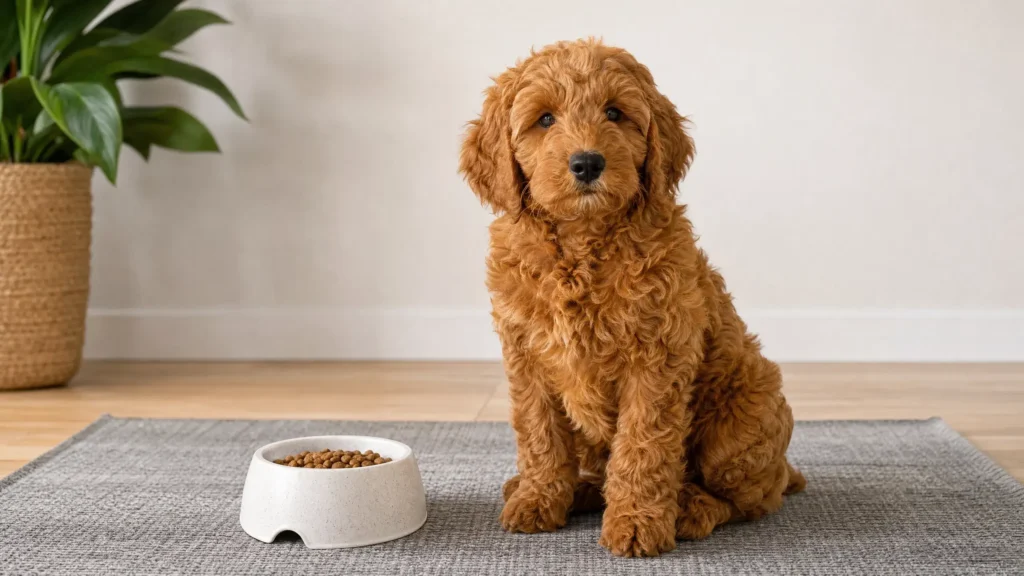
Meal frequency for a Mini Goldendoodle drops from 3 to 4 times a day as a young puppy down to 2 times a day as an adult. This shift tracks directly with stomach capacity and metabolism, both of which change as the puppy grows, and getting the timing right matters almost as much as getting the amount right.
A puppy from 8 to 12 weeks old needs 3 to 4 meals a day spaced evenly from morning to evening. From 3 to 6 months, most Mini Goldendoodles do well on 3 meals a day as their stomach capacity increases, and by 12 months, nearly all of them are settled into a twice-daily adult schedule, usually one meal in the morning and one in the evening.
When to Switch from 3 Meals to 2 Meals
Most Mini Goldendoodles are ready to drop to 2 meals a day somewhere between 6 and 9 months old, earlier than larger Goldendoodle sizes that often wait until 8 to 10 months. A few signs tell you your puppy is ready before you make the switch.
- Consistent leftovers. Your puppy regularly leaves food in the midday bowl instead of finishing it.
- Reduced interest. Your puppy shows less enthusiasm for the third meal compared to morning and evening feedings.
- Stable weight gain. Your puppy has been gaining weight steadily without sudden drops or spikes for at least two weeks.
Make the switch gradually over 2 to 3 weeks by increasing morning and evening portions slightly while phasing out the midday meal, rather than dropping it all at once. Puppies who go cold turkey on a meal tend to act hungrier and beg more at the remaining two, which is usually a sign the transition happened too fast.
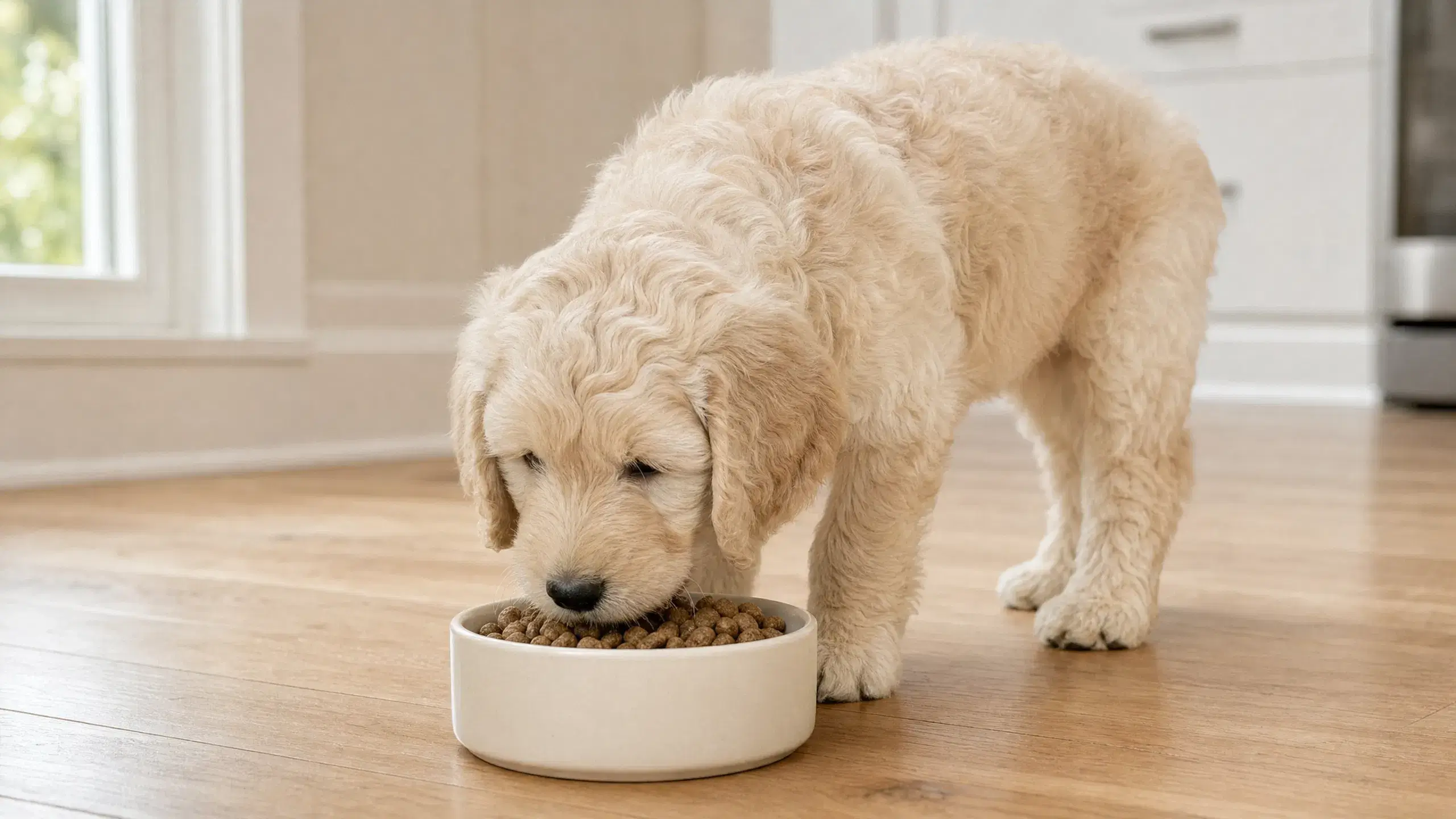
Scheduled feeding, offering food at set times and removing the bowl after 15 to 20 minutes, works better for Mini Goldendoodles than free feeding, where food stays out all day. This breed’s Golden Retriever ancestry gives it a strong appetite and a tendency to overeat if food is always available, and scheduled feeding also makes it far easier to notice appetite changes early, which is often the first sign of illness or stress.
Choosing the Right Food Type and Formula
A high-quality dry kibble formulated for puppies or small breeds is the most practical choice for most Mini Goldendoodle owners, though wet food and raw diets both have a place depending on your goals. The right formula matters more than the specific brand name on the bag. Look for a nutritional adequacy statement confirming the food meets AAFCO’s Growth and Reproduction or All Life Stages nutrient profile, the baseline standard most veterinarians recommend checking first.
Skipping that statement is one of the more common mistakes new owners make when picking a bag off the shelf based on packaging alone.
Dry vs Wet vs Raw: Which Is Best
Dry kibble is the most convenient and cost-effective option for daily feeding, while wet food and raw diets work well as occasional additions or for picky eaters. Dry vs wet food for puppies comes down mainly to convenience, cost, and palatability, since regular kibble offers little to no meaningful dental benefit over soft food unless it’s a dental-specific formula accepted by the Veterinary Oral Health Council. Raw diets require more careful planning to stay nutritionally complete and are best discussed with a veterinarian before switching a growing puppy over entirely, especially since a poorly balanced homemade raw diet can create real nutrient gaps during a stage where the puppy has little margin for error.
Puppy Formula vs Adult Formula
Puppy formula should stay on the menu until your Mini Goldendoodle reaches close to its full adult size, typically around 12 months. Growth-stage food contains higher protein, fat, calcium, and phosphorus levels than adult maintenance formulas, supporting the bone and muscle development a growing puppy needs, and switching to adult food too early can leave a still-growing puppy short on the nutrients it needs during its final growth phase.
What to Look for in a Small-Breed Puppy Food Label
A handful of label details separate a solid small breed puppy formula from a generic one.
- AAFCO statement. The label should confirm the food meets AAFCO’s Growth or All Life Stages profile, according to the FDA’s guidance on complete and balanced pet food.
- Kibble size. Smaller kibble pieces are easier for a Mini Goldendoodle’s smaller mouth and jaw to chew comfortably.
- Named protein source. A named meat, such as chicken or salmon, listed first is a stronger sign of quality than a generic “meat meal.”
- DHA inclusion. Added DHA supports brain and vision development during the puppy growth window.
Weight Management and Body Condition
You can tell if your Mini Goldendoodle is at a healthy weight by feeling its ribs and checking its waistline, not by relying on the scale number alone. Two dogs at the same weight can have very different body compositions, so a hands-on check gives a clearer picture than pounds alone, and this matters even more for a breed already prone to joint strain from its Golden Retriever lineage.
How to Tell If Your Mini Goldendoodle Is Overweight or Underweight
A healthy weight for a mini goldendoodle shows up as easily felt ribs with a thin layer of fat and a visible waist when viewed from above. According to VCA Animal Hospitals, this hands-on assessment, known as body condition scoring, is more reliable than weight alone because it accounts for muscle and frame differences between individual dogs.
A few clear signs point to either extreme.
- Ribs too easy to see. Visible ribs with no fat covering and a sharply tucked waist suggest your dog is underweight.
- Ribs hard to feel. Ribs buried under a thick fat layer with no visible waist suggest your dog is overweight.
- Sudden weight change. Rapid gain or loss over a few weeks, rather than gradual and expected growth, is worth a vet visit regardless of the direction.
Adjusting Portions Based on Body Condition
Adjust food gradually rather than making dramatic cuts or increases when your dog’s body condition shifts. VCA Animal Hospitals notes that dogs are considered overweight at 10 to 20 percent above ideal body weight and obese beyond that, and that simply slashing portions can create nutrient gaps rather than solving the underlying issue.
The mini goldendoodle obesity risk is real given the breed’s Golden Retriever heritage. Monthly weigh-ins alongside a hands-on body condition check catch problems before they become harder to reverse, and the habit costs a few minutes a month against months of harder work reversing established weight gain later.
Treats and Food Transitions
Treats should make up no more than 10 percent of your Mini Goldendoodle’s total daily calories, with the rest coming from a complete and balanced main diet. This limit keeps training rewards from crowding out the nutrients your dog needs from its regular food. Food changes deserve the same careful approach, since a sudden switch is a common cause of digestive upset in this breed.
How Many Treats Are Safe Per Day
Keeping treats within about 10 percent of your Mini Goldendoodle’s daily calories usually leaves room for a modest number of small training treats spread across sessions, though the exact count depends on the treat’s size and calorie content. Low-calorie options such as small pieces of cooked chicken or freeze-dried liver work well without adding excess fat. If you’re using treats heavily for training, cut back the main meal slightly that same day to keep total calories consistent.
How to Switch Foods Without Stomach Upset
Switching a Mini Goldendoodle’s food over 7 to 10 days, gradually increasing the new food while decreasing the old one, prevents the diarrhea and vomiting that often follow an abrupt change.
Start with roughly 25 percent new food mixed into 75 percent old food for the first two to three days, then move to a 50-50 mix, then 75 percent new, before finishing on the new food entirely. This slower pace gives the gut bacteria time to adjust to the new ingredients, and owners who rush this window are usually the ones who end up calling their vet about loose stool a few days later.
Signs of Food Allergies or Sensitivities
Mini goldendoodle food allergies typically show up as skin or digestive symptoms rather than obvious behavioral changes, which is why they’re easy to miss at first.
- Itchy skin or paws. Frequent scratching, licking, or paw-chewing without fleas present often points to a food sensitivity.
- Chronic soft stool. Ongoing loose stool that doesn’t resolve with a stable diet suggests the current food isn’t agreeing with your dog.
- Recurring ear infections. Repeated ear issues are one of the more commonly overlooked signs of an underlying food allergy.
If you notice these signs, a vet-guided elimination diet is the most reliable way to identify the specific trigger rather than guessing and switching brands repeatedly.
Cost and When to Get Professional Guidance
Feeding a Mini Goldendoodle typically costs somewhere in the range of $40 to $80 a month depending on food quality and brand, or roughly $500 to $1,000 a year. Higher-end formulas with named meat proteins and limited fillers sit at the top of that range, while mid-tier commercial kibble sits toward the bottom, and budgeting for food should also account for treats and any supplements your vet recommends.
Monthly and Yearly Cost of Feeding a Mini Goldendoodle
The cost to feed a mini goldendoodle scales with both the dog’s size and the quality tier of food chosen, landing most owners in roughly the $40 to $80 monthly range. A 30-pound adult eating 2 cups of premium kibble daily will cost more per month than the same dog on a budget-tier formula, even though both meet basic AAFCO standards.
Buying in bulk and choosing a formula with higher calorie density per cup can lower the monthly total, since a denser kibble means smaller daily portions for the same energy intake.
When to Consult a Vet About Your Puppy’s Diet
Book a vet visit when questions about your dog’s diet go beyond routine portion adjustments, such as persistent digestive issues, unexplained weight change, or suspected allergies. A veterinarian can also recommend joint-support supplements like glucosamine and chondroitin, worth discussing given this breed’s predisposition to hip and joint strain as it ages. Annual checkups are a natural time to reassess feeding amounts as your dog’s activity level and metabolism shift with age.
Frequently Asked Questions
How much should I feed my Mini Goldendoodle puppy?
Feed 1 to 1.5 cups a day for puppies 8 to 12 weeks old, increasing to 1.5 to 2.5 cups by 6 to 12 months as they approach adult size. Exact amounts depend on your food’s calorie density, so always cross-check with the bag’s own feeding guide.
How many times a day should I feed a Mini Goldendoodle?
Puppies under 6 months typically need 3 to 4 meals a day, while most Mini Goldendoodles transition to 2 meals a day between 6 and 9 months old. Adults stay on a twice-daily schedule for life.
When should I switch my Mini Goldendoodle from puppy food to adult food?
Most Mini Goldendoodles are ready to switch to adult food around 12 months old, once growth has leveled off and weight has stayed steady for several weeks. Switching too early can leave a still-growing puppy short on the protein and calcium it needs.
Can I free-feed my Mini Goldendoodle instead of scheduling meals?
Scheduled feeding works better for this breed, since Mini Goldendoodles tend to overeat when food is left out all day. Set meal times also make it easier to notice early signs of appetite changes or illness.