
Table of Contents:
- English vs American Golden Retriever: What’s Actually Different
- Is “English” a Recognized Breed or a Bloodline Label
- Appearance, Build, and Coat Color
- Temperament: How English Lineage Changes Personality
- Size and Generations
- Health, Lifespan, and Separating Fact From Breeder Claims
- Price, Sourcing, and Choosing a Reputable Breeder
- Frequently Asked Questions
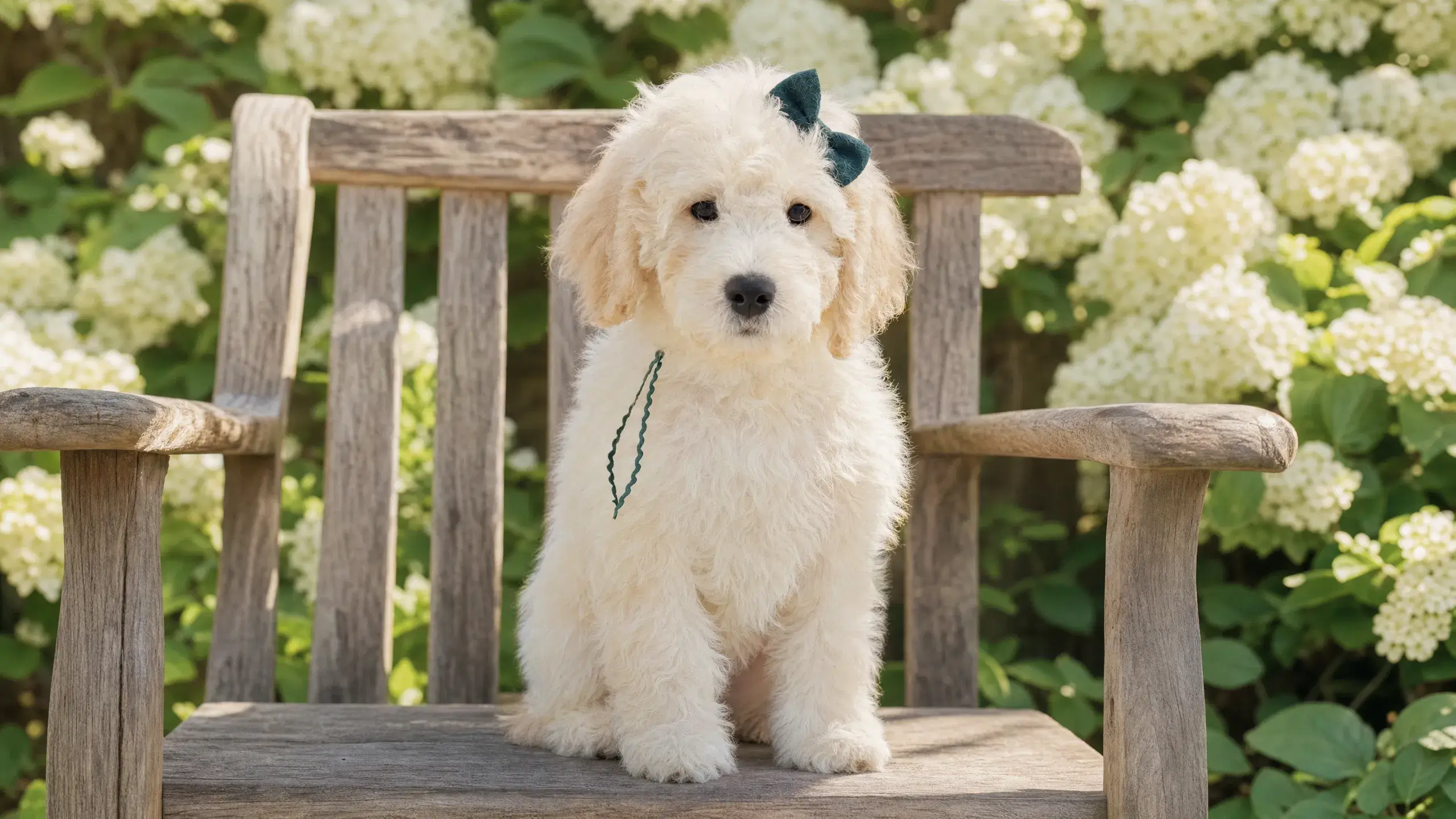
An English Mini Goldendoodle is a cross between an English Cream Golden Retriever and a Miniature or Toy Poodle, not a separate breed. The “English” label refers to a Golden Retriever bloodline known for a lighter cream coat and a stockier build, bred to the same small Poodle types used for any Mini Goldendoodle.
English vs American Golden Retriever: What’s Actually Different
The main differences between English and American Golden Retrievers are build and coat color, not a different breed or bloodline pedigree. English-type Goldens tend to run stockier and shorter, with a blockier skull, rounder eyes, and a paler cream to gold coat, while American-type Goldens are typically leaner with a richer golden coat and more triangular eye shape. Both types fall under the same AKC breed standard for Golden Retrievers in the United States, and the “English” distinction really reflects which country’s Kennel Club standard a breeder is following.
| Trait | English-Type Golden Retriever | American-Type Golden Retriever |
| Height (male) | Approximately 22 to 24 inches | 23 to 24 inches |
| Weight (male) | Approximately 65 to 75 lbs | 65 to 75 lbs |
| Build | Stockier, blockier frame | Leaner, more athletic frame |
| Coat color | Pale cream to light gold | Richer gold to red-gold |
| Eye shape | Round | More triangular |
Is “English” a Recognized Breed or a Bloodline Label
“English” is a bloodline and marketing label, not a breed recognized separately by any kennel club. The Golden Retriever Club of America directly addresses this point, noting that calling these dogs “English Cream Golden Retrievers” is technically inaccurate since most aren’t even bred in England, and that cream coloring has always existed within the normal Golden Retriever color range. Buyers should treat “English” as a description of coat and build preference rather than proof of a rarer or purer bloodline.

English Mini Goldendoodle
Appearance, Build, and Coat Color
An English Mini Goldendoodle typically has a pale cream to apricot coat and a stockier, more compact frame than a standard American-line Mini Goldendoodle. This look comes directly from the English Cream Golden Retriever parent, whose blockier head and paler coloring pass down even when crossed with a Poodle. Coat texture and shedding, though, depend more on the Poodle side of the pairing than on which Golden Retriever type is involved.
Coat Colors and Texture Compared
The most common English Mini Goldendoodle coat colors are cream, champagne, and apricot, with red showing up occasionally and true merle patterns appearing rarely in multigenerational litters. Coat texture ranges from wavy to curly depending on how much Poodle influence the puppy inherited, and coat length typically continues developing until the dog reaches full maturity around 18 to 24 months old.
- Cream and champagne. The palest shades, coming directly from the English Cream Golden Retriever’s signature coloring, and the most commonly marketed color for this type.
- Apricot. A warmer, slightly deeper tone that still reads as light compared to a standard golden Goldendoodle coat.
- Red. Less common in English lines specifically, though it can appear depending on the individual dog’s genetics.
- Merle. A rare, patterned coat that can only appear if a merle-carrying parent is somewhere in the pedigree, usually introduced through certain Poodle lines rather than the English Golden Retriever side, and isn’t something a straightforward English cross produces on its own.
Why the “Teddy Bear” Build Comes From the English Line
The rounder, plusher “teddy bear” appearance associated with this type comes from specific inherited traits in the English Cream Golden Retriever parent. A handful of physical markers consistently set this build apart from a leaner, American-line Mini Goldendoodle.
- Blockier skull. A broader, flatter forehead compared to the more tapered skull of an American-line Golden Retriever.
- Rounder eyes. Large, round, dark eyes rather than the more almond or triangular shape seen in American lines.
- Shorter, wider muzzle. Contributes to the softer, more rounded facial expression that drives the “teddy bear” comparison.
- Stockier frame. A heavier-boned, more compact body rather than the leaner, longer-legged American build.
Does Coat Color Affect Shedding or Grooming
Coat color has no meaningful effect on shedding or grooming needs, since both come almost entirely from the Poodle side of the cross. An F1B English Mini Goldendoodle, bred back to a Poodle for a higher Poodle percentage, sheds less regardless of whether its coat is cream, apricot, or red. Buyers drawn specifically to a lighter coat should know they aren’t necessarily getting a lower-shedding or more hypoallergenic dog just because the color happens to be paler.
Temperament: How English Lineage Changes Personality
English Mini Goldendoodle temperament tends to run calmer and more even-keeled than standard American-line Mini Goldendoodles, according to breeders who work with both types, though this isn’t backed by a controlled study. English Cream Golden Retrievers are frequently described as steadier and less high-energy than their American counterparts, a trait that often carries through the cross. That said, individual temperament still depends heavily on socialization, training, and the specific Poodle parent involved, not lineage alone.
English Mini Goldendoodle vs Standard Mini Goldendoodle Temperament
A calmest doodle comparison between English and American-line Mini Goldendoodles usually favors the English type, though the gap is more subtle than most marketing suggests. English lines are commonly described as more relaxed indoors and less prone to the higher-energy bursts associated with American-line Goldens. Both types remain highly trainable and food-motivated thanks to the shared Poodle influence, so the practical difference in a day-to-day household is often smaller than breeder descriptions imply.
Why English Lines Are Popular for Therapy and Service Work
English-line Goldendoodles are frequently chosen for therapy and service roles because of their steadier, less reactive temperament under pressure. A calm baseline disposition matters more in these roles than raw trainability, since therapy and service dogs need to stay composed in unpredictable environments like hospitals or crowded public spaces. This reputation is well-documented anecdotally among trainers and breeders, though it reflects a general tendency rather than a guarantee for any individual puppy.

Mini Goldendoodle
Size and Generations
An English Mini Goldendoodle typically weighs 15 to 35 pounds and stands 13 to 19 inches tall, depending on whether the Poodle parent was Toy or Miniature. Generation also plays a role in predictability, since F1 puppies vary more in size and coat than F1B or multigenerational litters. Understanding both factors together gives a much clearer picture than looking at breed type alone.
How Big Does an English Mini Goldendoodle Get
Size depends primarily on the Poodle parent’s size rather than on the English Golden Retriever side. A Toy Poodle cross tends to land toward the smaller end of the overall range, while a Miniature Poodle cross tends toward the larger end, though breeders don’t publish a precise weight cutoff between the two.
| Poodle Parent | Size Trend | Typical Adult Range |
| Toy Poodle cross | Smaller end of the range | 15 to 35 lbs, 13 to 19 inches |
| Miniature Poodle cross | Larger end of the range | 15 to 35 lbs, 13 to 19 inches |
F1 vs F1B: Which Generation Fits Your Needs
An F1 English Mini Goldendoodle is a straightforward 50/50 cross and offers the most balanced mix of English Golden Retriever and Poodle traits, while an F1B is bred back to a Poodle for a coat that sheds less and suits allergy-sensitive households better. F1 puppies tend to retain more of the English Golden Retriever’s build and coloring, while F1B puppies lean more toward the Poodle’s curl and lower-shedding coat. Multigenerational litters, bred from two Goldendoodle parents, offer the most predictable outcome overall but are less common and typically cost more.
Health, Lifespan, and Separating Fact From Breeder Claims
There’s no scientific evidence that English lineage makes a Mini Goldendoodle healthier or longer-lived than an American-line one, despite this being one of the most common claims in breeder marketing. Golden Retrievers as a breed, regardless of type, carry a well-documented predisposition to certain cancers, and this risk applies across bloodlines rather than being specific to American lines. Buyers should treat health and longevity claims tied specifically to “English” ancestry with real skepticism.
What’s Actually Documented About English Line Health
Golden Retrievers overall face a notably high cancer risk, a finding confirmed by Morris Animal Foundation’s Golden Retriever Lifetime Study, the largest and longest-running canine health study of its kind. As of the Study’s 10-year update, cancer-related deaths accounted for roughly 75 percent of all deaths recorded among its more than 3,000 enrolled dogs. Crossing with a Poodle can introduce hybrid vigor, the genetic diversity benefit common to crossbred dogs, but nothing in the current research ties that benefit specifically to English-line ancestry over American-line ancestry.
Are “Longer Lifespan” and “Lower Cancer Risk” Claims Accurate
Claims that English lines live longer or face lower cancer risk are not supported by any published study. The club notes that cream-colored dogs are frequently promoted as healthier or more valuable without evidence, and that coat color has no established connection to health outcomes. A few specific claims are worth watching for when researching a breeder.
- “Lower cancer rate” percentages. Specific statistics like a stated percentage reduction in cancer risk rarely trace back to any published, peer-reviewed source.
- “Rare” or “imported” bloodline language. Terms like “Rare White European” describe marketing positioning more than a genuinely distinct or scarce bloodline.
- “Healthier by design” framing. Crossbreeding can offer real hybrid vigor benefits, but that applies to Poodle crosses generally, not specifically to English-line dogs over American-line dogs.
How Long Do English Mini Goldendoodles Live
Most English Mini Goldendoodles live 10 to 15 years, in line with the general Goldendoodle lifespan range rather than any extended figure tied specifically to English ancestry. Smaller individuals within this range often land toward the higher end, since smaller body size across dog breeds generally correlates with longer lifespan. Regular veterinary care and weight management influence longevity far more than which Golden Retriever type sits in the pedigree.
Price, Sourcing, and Choosing a Reputable Breeder
English Mini Goldendoodle puppies typically cost several hundred dollars more than standard-coat Mini Goldendoodles, largely due to demand for the cream coat rather than any documented health or temperament advantage. Coat color and the word “English” itself drive a meaningful part of the price premium in this market. Knowing what to verify before paying that premium protects buyers from paying for marketing language alone.
Why English-Line Puppies Typically Cost More
Price increases mostly track coat color popularity and perceived rarity rather than genuine differences in health or quality. Breeders marketing “English” or “cream” puppies often charge more simply because demand for that look outpaces supply, not because the puppies underwent different health screening or come from a demonstrably superior bloodline. A responsible breeder should be able to explain their pricing beyond coat color alone.
Questions to Ask Before Trusting an “English Lines” Claim
A short list of questions separates breeders making honest claims from those relying on marketing language alone.
- Ask for the Golden Retriever parent’s registration. A legitimate breeder can show AKC or applicable Kennel Club registration for the Golden Retriever parent, regardless of its coat color.
- Ask what health testing was done. OFA hip and elbow clearances, along with heart and eye screening, matter more than coat color or the word “English” on a website.
- Ask for the source of any health claims. If a breeder cites a specific statistic about cancer risk or lifespan, ask where that figure comes from and whether it’s been published anywhere.
- Ask to see both parents. Seeing the actual Golden Retriever and Poodle parents gives a far more reliable sense of temperament and build than marketing photos alone.
Frequently Asked Questions
Is an English Mini Goldendoodle a different breed from a regular Mini Goldendoodle?
No. Both come from the same Golden Retriever and Poodle cross, and “English” simply describes the Golden Retriever parent’s bloodline, coat color, and build rather than a separate breed.
Do English Mini Goldendoodles shed less than other Mini Goldendoodles?
Shedding depends on the Poodle side of the pairing and the specific generation, not on whether the Golden Retriever parent is English or American type. An F1B of either type will generally shed less than an F1 of either type.
Are English Mini Goldendoodles calmer than other Mini Goldendoodles?
Breeders commonly report calmer temperaments in English lines, and this is consistent with general descriptions of English Cream Golden Retrievers. It isn’t guaranteed for every individual puppy, since training and socialization still play a major role.
Do English Mini Goldendoodles really have fewer health problems?
There’s no published research supporting this claim specifically. Golden Retrievers as a breed carry a well-documented cancer risk regardless of lineage, and hybrid vigor from the Poodle cross applies to any Goldendoodle type, not English lines exclusively.
How big does an English Mini Goldendoodle get?
Most reach 15 to 35 pounds and stand 13 to 19 inches tall, depending on whether the Poodle parent was a Toy or Miniature. The Poodle side determines size far more than the Golden Retriever side does.
Why are English Mini Goldendoodles more expensive?
The price premium mostly reflects demand for the cream coat color rather than any documented difference in health, temperament, or quality. Coat color popularity, not lineage superiority, is the main driver.