Table of Contents:
- What Makes a Mini Goldendoodle Black: Genetics and Color Origin
- Do Black Mini Goldendoodles Stay Black
- Black Mini Goldendoodle Size, Appearance and Full Grown Profile
- Temperament, Personality and Family Fit
- Grooming, Shedding and Black Coat Care
- Conclusion
- FAQ
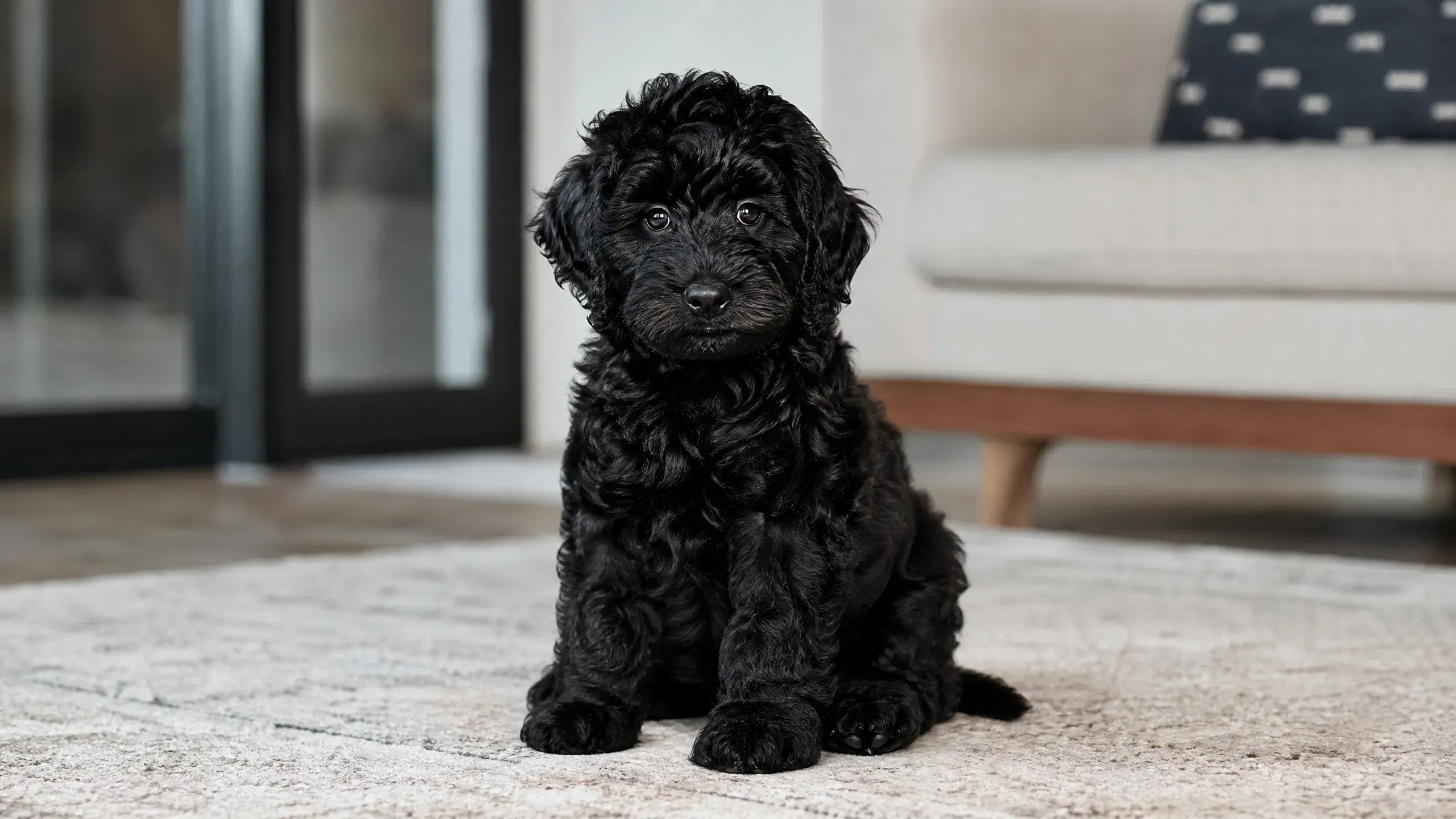
The black Mini Goldendoodle is one of the least common color variations in the breed and one of the most searched. This guide covers everything that makes black coats different from standard golden or apricot coats: where the color comes from genetically, whether it fades, what the coat requires, and what to expect in terms of size, temperament, and cost.
What Makes a Mini Goldendoodle Black: Genetics and Color Origin
The black coat in a black Mini Goldendoodle comes entirely from the Poodle side of the lineage. Golden Retrievers do not carry the gene for solid black coats. Their genetics produce only shades of gold, cream, and red. To produce a black puppy, a breeder must pair a Poodle carrying dominant black pigmentation (controlled by the KB locus) with a Goldendoodle parent that does not suppress that expression through competing color genes.
Black coat production depends on eumelanin, the dark pigment responsible for black, brown, and gray coloring in dogs. When eumelanin is fully expressed without dilution or override from the Golden Retriever’s yellow pigment pathway (the E locus), the result is a solid black coat. This is why not every litter from a black Poodle parent produces black puppies. The Golden Retriever’s genetic contribution can suppress the black expression in some offspring while allowing it in others within the same litter.
Why Black Mini Goldendoodles Are Rarer Than Other Colors
Black Mini Goldendoodles are genuinely rare because the genetics required to produce them are less common in standard Goldendoodle breeding programs. Most breeders historically selected for golden, apricot, and cream coats that mirror the Golden Retriever’s classic appearance, meaning black Poodle lines were used less frequently. Black puppies appear in fewer litters and in smaller numbers per litter when they do appear.
Rarity has a practical implication for buyers: waiting lists for black Mini Goldendoodle puppies from reputable breeders are typically 6 to 12 months longer than for standard colors. Buyers should also be cautious of breeders who claim to reliably produce all-black litters. This level of color consistency in a hybrid breed requires careful multi-generation planning and documented Poodle lineage, not chance.
Black Coat Patterns: Solid, Phantom, Parti and Tuxedo
Not all black Mini Goldendoodles are solid black. Several distinct patterns are possible:
- Solid black. The entire coat is a uniform deep black with no secondary color present. This is the rarest and most sought-after pattern, requiring both parents to carry and express the dominant black gene without interference from parti or phantom modifiers.
- Black phantom. A black base coat with clearly defined tan or apricot points above the eyes, on the muzzle, chest, legs, and under the tail, similar to the pattern seen in Rottweilers and Dobermans. The tan points come from the agouti gene (A locus) expressing alongside the black base.
- Black and white parti. A coat that is more than 50% white with irregular black patches. Parti patterning requires two copies of the parti gene and produces highly individual markings, so no two parti dogs look alike.
- Tuxedo. A specific parti variation where black covers the back and head while white appears on the chest, chin, paws, and sometimes a facial blaze. The tuxedo pattern is one of the most visually striking coat combinations in the breed.
Do Black Mini Goldendoodles Stay Black
Many black Mini Goldendoodles stay black for life, but a significant percentage will fade. The outcome is determined before birth by which genes the puppy inherited from its Poodle parent. This is the most important piece of information for buyers attracted to the black coat, and it is also the most poorly explained topic across competing articles.
The variable is whether the Poodle parent carries the progressive graying gene (also called the fading gene or the G locus variant). Poodles that carry this gene, common in silver and blue Poodle lines, produce puppies whose black coats begin lightening at 6 to 12 months of age. A puppy that is jet black at 8 weeks can mature into charcoal, slate gray, or soft silver by 18 to 24 months. Poodles without this gene produce puppies whose black coats are stable and remain dark throughout their lifetime.
The Progressive Graying Gene: What It Is and How to Spot It
The progressive graying gene operates gradually and predictably, which means buyers can look for early signals before committing. The Veterinary Genetics Laboratory at UC Davis documents coat-related gene loci in dogs, including the inheritance patterns that affect color stability in Poodle lines. The G locus variant is dominant, meaning only one copy is needed to produce fading. A Poodle parent with even one copy of this variant is likely to pass fading traits to a proportion of its offspring.
Early signs that a black puppy may fade:
- Lighter roots visible at 8 to 12 weeks. Run your fingers against the grain of the puppy’s coat. If the hair near the skin looks gray or brownish rather than true black, fading is likely already underway.
- Gray or silver tint around the muzzle and eyes. Fading typically begins at the face before spreading to the body. A puppy showing this at 10 to 14 weeks will almost certainly continue to lighten.
- Known sire or dam coat history. If either parent’s coat faded from black to gray between 1 and 3 years of age, the puppies have a high probability of the same outcome.
How to Ask Your Breeder About Fading Before You Buy
A reputable breeder can tell you whether their Poodle parent line carries the progressive graying gene. If they cannot answer this question, that is itself a red flag. When evaluating a black Mini Goldendoodle breeder, ask these questions directly:
- Has the Poodle parent or grandparent been color-tested for the G locus variant?
- Are there photos of adult dogs from previous litters showing coat color at 2 to 3 years of age?
- What is the coat color history of the dam and sire? Did either fade from black?
Breeders who track lineage carefully and run genetic color panels can give you a reliable prediction. Those who cannot provide parent photos or lineage documentation are selling on appearance alone.
Black Mini Goldendoodle Size, Appearance and Full Grown Profile
A full grown black Mini Goldendoodle weighs between 15 and 35 pounds and stands 13 to 20 inches tall at the shoulder, identical to other Mini Goldendoodle color variations. Coat color has no effect on body size. The Miniature Poodle parent is the primary size determinant. A breeder using a 12-pound Miniature Poodle sire will consistently produce adults toward the lower end of this range, while a 20-pound Miniature Poodle sire typically produces adults in the 25 to 35 pound range.
Most black Mini Goldendoodles reach full adult size between 11 and 14 months. Growth is largely complete by month 10, with the final 5 to 10% of size added in the last few months. The most reliable size predictor is parent weights. Ask your breeder for both parents’ adult measurements rather than relying on general breed averages.
| Size Metric | Black Mini Goldendoodle |
| Adult weight range | 15–35 lbs |
| Adult height range | 13–20 inches |
| Full grown age | 11–14 months |
| Size determinant | Miniature Poodle parent weight |
| Color effect on size | None |
Coat Texture and Curl Type in Black Mini Goldendoodles
The black coat’s texture, curl pattern, and maintenance demands are determined by generation, not color. An F1BB black Mini Goldendoodle (87.5% Poodle) will have a tightly curled coat that requires daily brushing and professional grooming every 6 to 8 weeks. An F1 black Mini Goldendoodle (50% Poodle) is more likely to produce a wavy coat that mats less readily but may shed slightly more.
Black coats in curly-coated dogs have one visual characteristic worth noting: matting and debris are harder to spot against a dark background than on a cream or apricot coat. Owners of black Mini Goldendoodles need to physically feel through the coat, particularly behind the ears, under the collar, and in the leg joints, rather than relying on visual inspection alone.
Temperament, Personality and Family Fit
The black Mini Goldendoodle has exactly the same temperament as any other Mini Goldendoodle color: friendly, intelligent, people-oriented, and highly trainable. Coat color has no documented effect on canine personality. Temperament in this breed is shaped by genetics (generation and parent temperament), early socialization, and training.
The combination of Poodle intelligence and Golden Retriever warmth produces a dog that bonds quickly with its family, adapts well to different living environments, and responds enthusiastically to positive reinforcement training.
Does a Black Coat Mean a Different Personality?
No. A black Mini Goldendoodle’s personality is not different from a cream or apricot Mini Goldendoodle’s. The belief that dark-coated dogs have different temperaments has no genetic or behavioral basis. What does affect temperament is the generation: a higher Poodle percentage (F1B or F1BB) produces a dog that is sharper, more alert, and more task-focused, while an F1 generation dog tends to display a more balanced blend of Golden Retriever ease and Poodle intelligence.
Black dogs in general face a documented adoption bias known as “black dog syndrome.” Shelters consistently report that black dogs are adopted at lower rates than lighter-colored animals, a phenomenon covered in ASPCA resources. For buyers choosing a black Mini Goldendoodle, this bias works in reverse: the color is specifically sought after and commands a premium rather than a discount.
Grooming, Shedding and Black Coat Care
Black Mini Goldendoodles shed minimally. Coat color has no effect on shedding level, which is determined entirely by the furnishings gene and generation. A black F1BB Mini Goldendoodle sheds as little as any other F1BB; a black F1 may shed slightly more, regardless of color. The American College of Allergy, Asthma and Immunology confirms that dog allergies are triggered by proteins in dander and saliva, not hair color, so the hypoallergenic assessment for a black Mini Goldendoodle is identical to that of any other color.
The standard grooming schedule applies:
- Professional grooming every 6 to 8 weeks.
- Brushing 4 to 5 times per week for curly coats, 2 to 3 times for wavy coats.
- Bathing every 3 to 4 weeks.
- Ear cleaning every 2 weeks, given Poodle-dominant ear canal hair growth.
Black Coat Specific Concerns: Sun Bleaching and Coat Fading Prevention
Black Mini Goldendoodle coats are vulnerable to UV-induced color change, a separate issue from genetic fading. Extended sun exposure oxidizes the eumelanin in the coat, producing a reddish-brown tint along the back and top of the head where sun contact is highest. This is cosmetic and does not indicate a health problem, but it matters for owners who want to maintain a true, deep black coat.
Practical steps to protect a black coat from sun bleaching:
- Use a dog shampoo formulated for dark coats, such as products containing optical brighteners for black pigment. These are widely available from pet grooming brands.
- Limit prolonged midday sun exposure during peak UV hours (10am to 4pm) in summer months.
- Keep the coat well-conditioned. Dry, brittle hair oxidizes faster than a moisturized coat. A leave-in conditioning spray used 2 to 3 times per week helps maintain coat integrity.
- Rinse the coat with cool water after swimming in chlorinated pools, as chlorine accelerates pigment oxidation in dark coats.
Conclusion
The black Mini Goldendoodle is the same dog as any other Mini Goldendoodle in every way that matters for daily life – same temperament, same trainability, same size range, same grooming schedule, same health profile. What makes this color variant genuinely different is the pre-purchase research it requires.
FAQ
Are black Mini Goldendoodles hypoallergenic?
Yes, to the same degree as any Mini Goldendoodle of the same generation. Coat color has no effect on shedding or allergen production. Those traits are determined by the furnishings gene and Poodle percentage. An F1B or F1BB black Mini Goldendoodle will shed as minimally as a cream F1B or F1BB. No dog is completely allergen-free, but high-generation black Mini Goldendoodles are among the most allergy-friendly small dogs available.
Will my black Mini Goldendoodle puppy stay black as it grows up?
It depends on the genetics of the Poodle parent. Black Mini Goldendoodles from Poodle lines without the progressive graying gene will keep their black coat for life. Those from lines carrying the G locus fading variant typically begin lightening at 6 to 12 months, eventually settling into charcoal, silver, or gray tones by age 2. Ask your breeder for G locus test results and adult photos from previous litters before purchasing.
Does a black coat require special grooming compared to lighter colors?
The core grooming schedule is the same: brushing 3 to 5 times per week, professional grooming every 6 to 8 weeks, bathing every 3 to 4 weeks. Black coats have one specific vulnerability. UV exposure can cause a reddish-brown tint to develop on the back and head. Using a shampoo formulated for dark coats and limiting midday sun exposure protects the coat’s color integrity.