Table of Contents:
- Breed Origins and What Makes Each Dog Distinct
- Size, Appearance and Coat Differences
- Energy Level and Day-to-Day Personality
- Temperament With Families, Children and Other Pets
- Shedding, Coat and Allergy Suitability
- Health, Lifespan and Breeder Testing
- Price, Grooming and Total Cost of Ownership
- Which Breed Is Right for You?
- Conclusion
- FAQ
The Mini Goldendoodle and Mini Labradoodle are more alike than different. Both cross a Miniature Poodle with a popular retriever breed, both are low-shedding, and both are intelligent, people-oriented family dogs. The differences that actually matter come down to coat texture, energy level, and which retriever parent’s temperament suits your household better. This guide gives you those differences in specific, usable terms.
Breed Origins and What Makes Each Dog Distinct
Both breeds were developed to combine the Poodle’s low-shedding coat and high intelligence with a retriever’s friendly, trainable temperament. The Mini Goldendoodle crosses a Golden Retriever with a Miniature Poodle. The Mini Labradoodle crosses a Labrador Retriever with a Miniature Poodle. That difference in retriever parent is the single most important factor driving every meaningful distinction between the two breeds.
The Labradoodle has a longer documented history as an intentional cross. The first standard Labradoodle was bred in Australia in 1989 by Wally Conron at the Royal Guide Dog Association of Australia, specifically to create a hypoallergenic guide dog for a blind woman in Hawaii whose husband was allergic to dogs. The Mini Labradoodle followed as breeders began using Miniature Poodles to produce smaller versions of the original. Goldendoodles emerged in the 1990s in North America and Australia, inspired by the Labradoodle’s success. The Mini Goldendoodle became a recognized size category in the early 2000s when breeders began deliberately pairing Golden Retrievers with Miniature Poodles rather than Standard Poodles.
The Golden Retriever vs Labrador Retriever Difference: Why It Matters
The retriever parent determines the behavioral and physical character that distinguishes the two breeds. Golden Retrievers are bred for a gentle, affectionate, family-oriented temperament: calm indoors, playful outdoors, and consistently patient with children and other pets. Labrador Retrievers are more athletic and food-motivated, with higher baseline energy and a stronger drive for physical activity. These traits carry forward directly into the Mini Goldendoodle and Mini Labradoodle crosses, making the retriever comparison the most useful filter for buyers choosing between them.

Size, Appearance and Coat Differences
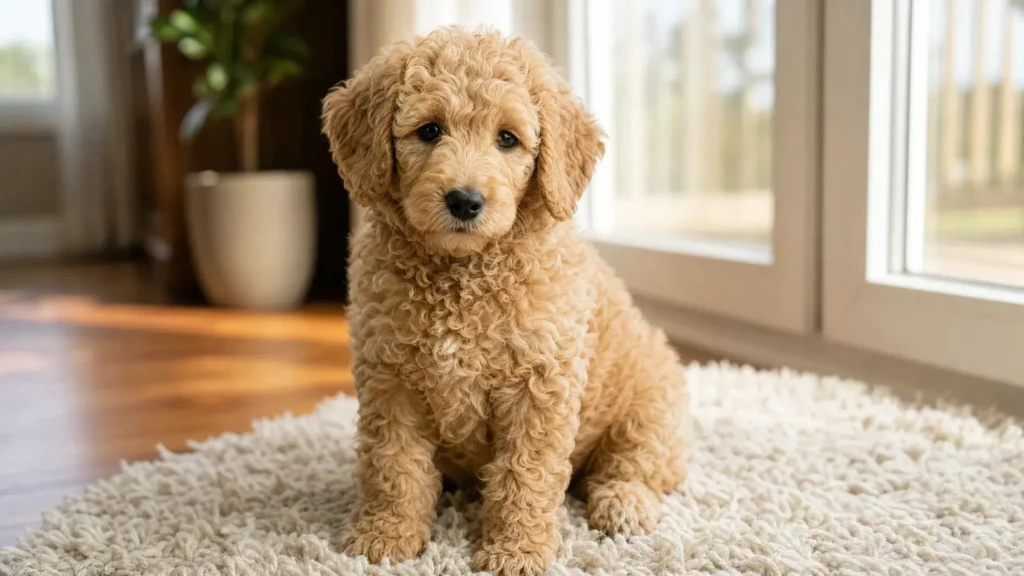
Mini Goldendoodles typically weigh 15 to 35 pounds and stand 13 to 20 inches tall. Mini Labradoodles typically weigh 15 to 25 pounds and stand 14 to 16 inches tall. In practice, Mini Labradoodles tend to be slightly more compact and sturdier in build, reflecting the Labrador’s broader, more muscular frame, while Mini Goldendoodles carry the Golden Retriever’s slightly slimmer, longer-snouted silhouette.
| Characteristic | Mini Goldendoodle | Mini Labradoodle |
| Adult weight | 15–35 lbs | 15–25 lbs |
| Adult height | 13–20 inches | 14–16 inches |
| Build | Slender, longer snout | Broader, more compact |
| Coat length | Longer, softer | Shorter, slightly coarser |
| Common colors | Cream, apricot, red, black, chocolate | Black, chocolate, red, silver, parti |
| Coat types | Wavy to curly | Wavy to curly, sometimes straighter |
Coat Texture and Color: Where the Breeds Visually Diverge
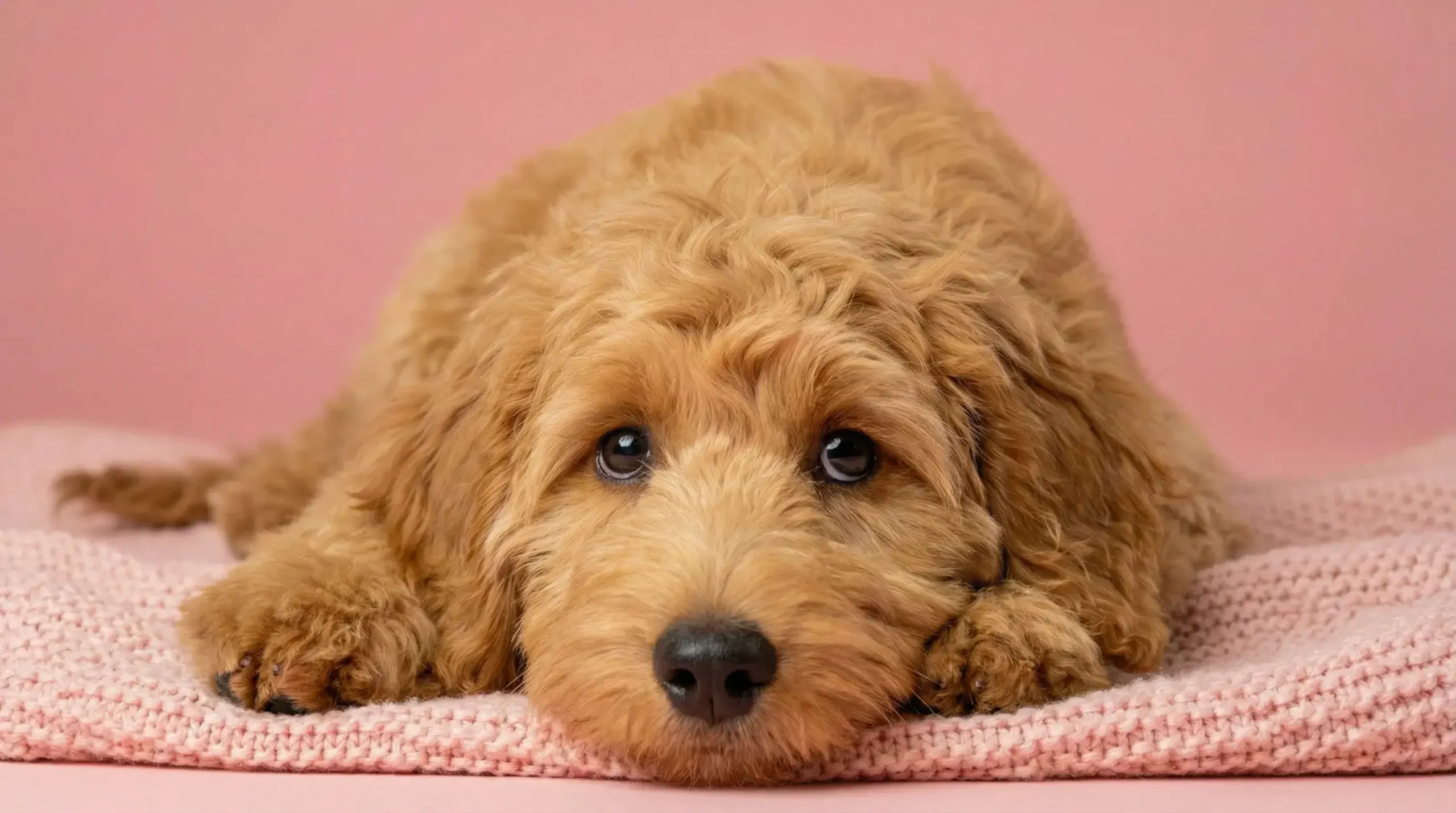
The coat difference between the two breeds is subtle but consistent. Mini Goldendoodles inherit the Golden Retriever’s longer, softer coat texture. Even in wavy or curly expressions, the coat tends to sit fuller and fluffier. Mini Labradoodles typically inherit a slightly shorter, denser coat from the Labrador side, which can feel marginally coarser to the touch. Both coat types require professional grooming every 6 to 8 weeks and brushing 3 to 5 times per week depending on curl tightness.
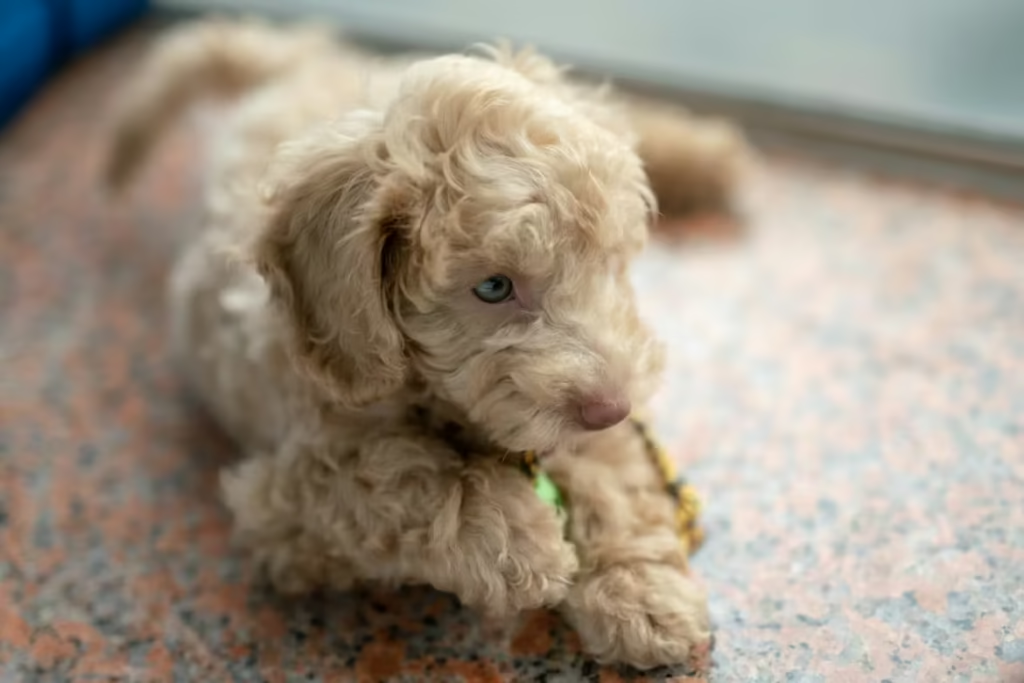
Mini Labradoodles also carry a broader color range than Mini Goldendoodles. Where the Mini Goldendoodle palette centers on warm tones (cream, apricot, red, gold, and occasionally black or chocolate), Mini Labradoodles regularly produce silver, blue, and parti-colored coats through the Labrador’s more diverse color genetics. For buyers with a specific color preference, this distinction is worth researching before committing to a breeder.
Energy Level and Day-to-Day Personality
Both breeds are affectionate, trainable, and social, but the Mini Goldendoodle has a reliably calmer indoor temperament than the Mini Labradoodle. This is the most practically significant behavioral difference between the two breeds. The Golden Retriever’s centuries of development as a gentle, patient companion dog produce a dog that settles more easily at home, recovers faster from excitement, and tends to be marginally less demanding of physical stimulation on a daily basis. The Mini Labradoodle, with Labrador energy on the non-Poodle side, tends to sustain higher physical drive throughout adulthood.
Energy Level and Exercise Requirements
Mini Labradoodles need 60 minutes or more of vigorous daily exercise. Mini Goldendoodles are well-served by 45 to 60 minutes of daily exercise, including a mix of walking, play, and mental stimulation. Both breeds are capable of apartment living when exercised adequately, but the Mini Labradoodle’s higher baseline energy makes it a better fit for households with outdoor access and an active daily routine.
Temperament With Families, Children and Other Pets
The Mini Goldendoodle is the stronger choice for households with young children. Its Golden Retriever heritage produces consistent gentleness, patience with toddlers, and a social ease that rarely tips into overexcitement during rough play. The Mini Labradoodle is equally affectionate but can be more boisterous with small children due to its higher physical energy, requiring earlier training to moderate jumping and exuberant greetings.
Both breeds integrate well with other pets when socialized during the critical early weeks of life, as documented by the American Veterinary Society of Animal Behavior. One meaningful difference: Mini Labradoodles can show mild wariness around strangers that the Mini Goldendoodle almost never exhibits. This is not aggression, but it does mean Mini Labradoodles benefit more from structured early socialization than their Goldendoodle counterparts.
What both breeds share on the behavioral side:
- Separation anxiety tendency. Both breeds bond closely with their families and experience genuine distress when left alone for extended periods without preparation. Crate training and gradual alone-time practice from puppyhood is essential for both.
- Food motivation. Both respond exceptionally well to treat-based training, making positive reinforcement the most efficient method for both breeds from day one.
- Trainability. Both rank among the easiest breeds to train in their size category. The shared Poodle intelligence combined with retriever eagerness to please produces dogs that pick up commands quickly and retain them reliably.
- Velcro dog tendency. Both breeds prefer to be near their people throughout the day. Buyers who work long hours from home will find either breed thrives in that environment; buyers who are away for 8 or more hours daily should plan structured enrichment and gradual independence training for either breed.
Shedding, Coat and Allergy Suitability
Both breeds produce low-shedding coats when the furnishings gene (RSPO2 variant) is present in the parent dogs, as documented by the UC Davis Veterinary Genetics Laboratory. At equivalent generations (F1B or F1BB for both), the shedding comparison is essentially equal. The Mini Goldendoodle has a slight advantage for allergy-sensitive households because its generation system is more standardized among breeders, making it easier to verify coat predictability before purchase. The American College of Allergy, Asthma & Immunology confirms that dog allergies are triggered by proteins in dander and saliva, not hair directly, so both breeds offer a meaningful but not absolute reduction in allergen exposure.
One practical difference: the Mini Labradoodle’s shorter, denser coat sometimes traps fewer loose hairs than the Mini Goldendoodle’s longer, softer coat, which can mean slightly less visible hair on furniture and clothing in non-shedding coat types. This is not a consistent rule across all dogs, but it is worth asking a breeder about parent coat types when purchasing either breed.
Health, Lifespan and Breeder Testing
Both breeds share a similar health profile because they draw from the same Poodle parent and from two retriever breeds with overlapping hereditary concerns. Common conditions to screen for in both include hip and elbow dysplasia, progressive retinal atrophy (PRA), and von Willebrand’s disease.
Mini Goldendoodles live 10 to 15 years. Mini Labradoodles live 12 to 14 years. Both lifespans are consistent with similar-sized hybrid breeds. The Mini Labradoodle carries one additional health consideration: Labrador Retrievers have a well-documented genetic predisposition to obesity through a POMC gene mutation that impairs the feeling of fullness after eating, as well as a higher incidence of exercise-induced collapse (EIC) than Golden Retrievers.
Price, Grooming and Total Cost of Ownership
Purchase prices for both breeds are comparable from reputable breeders: $2,000 to $4,000 for either a Mini Goldendoodle or Mini Labradoodle puppy. Regional demand, coat color, generation, and breeder reputation all influence where within that range a specific puppy falls. Ongoing costs are also similar:
- Grooming. Professional grooming every 6 to 8 weeks runs $60 to $120 per session for either breed, totaling $700 to $1,100 annually. Mini Labradoodles with shorter, less curly coats may require slightly less brushing time between appointments.
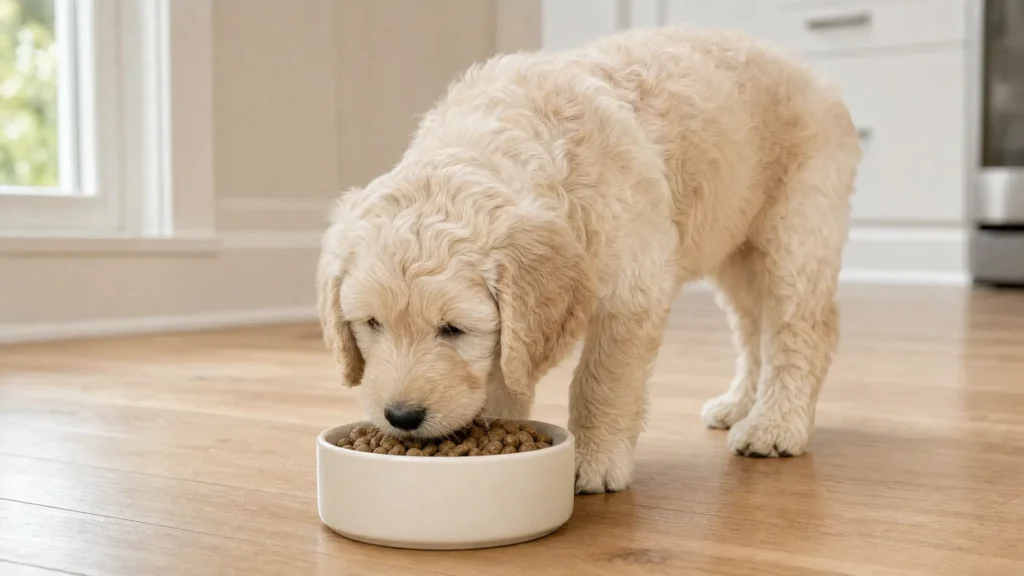
- Food and veterinary care. Both breeds in the 15 to 35 pound range consume $300 to $500 in quality dry kibble annually.
- Training. Both breeds are easy to train independently, but investing in puppy classes ($150 to $300 for a 6-week course) pays dividends for either breed, particularly in managing the separation anxiety and social exuberance both are prone to.
Which Breed Is Right for You?
The Mini Goldendoodle is the better choice for:
- Families with young children. The Golden Retriever’s patient, gentle temperament is the most reliable foundation for a child-friendly dog. The Mini Goldendoodle consistently delivers that quality across litters.
- First-time dog owners. The calmer indoor temperament and slightly lower physical drive make the Mini Goldendoodle marginally more forgiving for owners still developing their training and exercise routines.
- Allergy-sensitive households. The more standardized generation system gives buyers clearer control over coat predictability and shedding outcomes.
- Less active households. If daily exercise runs 45 minutes rather than 60 to 90 minutes, the Mini Goldendoodle is the more comfortable fit.
The Mini Labradoodle is the better choice for:
- Active singles and couples. Buyers who run, hike, or exercise vigorously daily will find the Mini Labradoodle’s higher physical drive a better match for their lifestyle.
- Buyers who want more color variety. The Labrador’s broader color genetics produce a wider palette of coat colors and patterns than the typical Mini Goldendoodle range.
- Households wanting a slightly more alert dog. The Mini Labradoodle’s mild wariness around strangers makes it marginally more attentive to new people and situations than the universally social Mini Goldendoodle.
Conclusion
The Mini Goldendoodle and Mini Labradoodle are genuinely close competitors. Both are low-shedding, both are easy to train, and either one will fit naturally into a family that provides consistent exercise, early socialization, and daily companionship. The decision comes down to one practical question: do you want a dog shaped more by Golden Retriever gentleness, or one shaped more by Labrador drive?
If the Mini Goldendoodle sounds like the right fit, Love of Puppies breeds health-tested Mini Goldendoodles with full genetic panels on both parents, early socialization, and a written health guarantee on every puppy.
FAQ
Is a Mini Goldendoodle calmer than a Mini Labradoodle?
Generally, yes. The Golden Retriever’s temperament produces a dog that settles more readily indoors and sustains lower baseline energy than the Labrador-influenced Mini Labradoodle. The difference is not dramatic. Both are active, people-oriented dogs. But it is consistent enough to be a meaningful filter for buyers choosing between the two. For households with young children or less active owners, the Mini Goldendoodle’s calmer indoor demeanor is a practical advantage.
Which breed sheds less?
At equivalent generations, both shed comparably when parent dogs carry the furnishings gene. The Mini Goldendoodle’s generation system (F1, F1B, F1BB) is more standardized among breeders, giving buyers clearer tools to select the lowest-shedding outcome. For the most allergy-sensitive households, an F1B or F1BB Mini Goldendoodle from DNA-tested parents is the most predictable choice.
Q: Which breed is better for families with kids?
The Mini Goldendoodle is the stronger choice for families with young children. Its Golden Retriever heritage produces consistent patience, gentleness, and social ease with toddlers and school-age children. The Mini Labradoodle is also excellent with children but can be more physically boisterous, which requires earlier and more consistent training to manage around small kids.