
Table of Contents:
- Breed Origins and What Makes Each Dog Different at the Core
- Size, Appearance and Coat: What You Will Actually Live With
- Temperament, Energy Level and Day-to-Day Personality
- Health, Lifespan and the Cost of Ownership Over Time
- Price, Grooming Costs and Total Cost of Ownership
- Which Breed Is Right for You
- Conclusion
- FAQ
Both the Cavapoo and the Mini Goldendoodle share a Poodle parent, both are low-shedding, and both are genuinely affectionate family dogs. The differences that actually matter for your household come down to three things: size, energy level, and long-term health profile. This guide covers all three in specific, comparable terms so you can make the decision confidently.
Breed Origins and What Makes Each Dog Different at the Core
The two breeds look similar on paper but diverge significantly in practice because their non-Poodle parents are fundamentally different dogs. The Mini Goldendoodle is a cross between a Golden Retriever and a Miniature Poodle. Goldendoodles were first bred in the 1960s and became widely popular in the 1990s in North America and Australia, originally developed as hypoallergenic guide dogs. The Cavapoo is a cross between a Cavalier King Charles Spaniel and a Miniature or Toy Poodle, first bred in Australia in the 1990s.
Both inherit Poodle intelligence and a low-shedding coat tendency. What changes everything is the other parent. The Golden Retriever contributes an athletic, outgoing, people-pleasing drive to the Mini Goldendoodle vs Cavapoo equation. The Cavalier King Charles Spaniel contributes a quieter, more clingy temperament and a significantly heavier cardiac disease burden that buyers must understand before purchasing.
The Shared Poodle Parent
The Poodle’s contribution, trainability, intelligence, and the furnishings gene that controls low-shedding coats, is present in both breeds. Beyond that, the difference between a Cavapoo and a Mini Goldendoodle is largely the difference between a Cavalier and a Golden Retriever. Cavaliers are bred lap dogs with centuries of companion history and a known predisposition to heart disease. Golden Retrievers are working retrievers bred for sustained outdoor activity, with a temperament shaped by cooperation and task focus. Those parent traits flow directly into every puppy produced by each cross.
Size, Appearance and Coat: What You Will Actually Live With
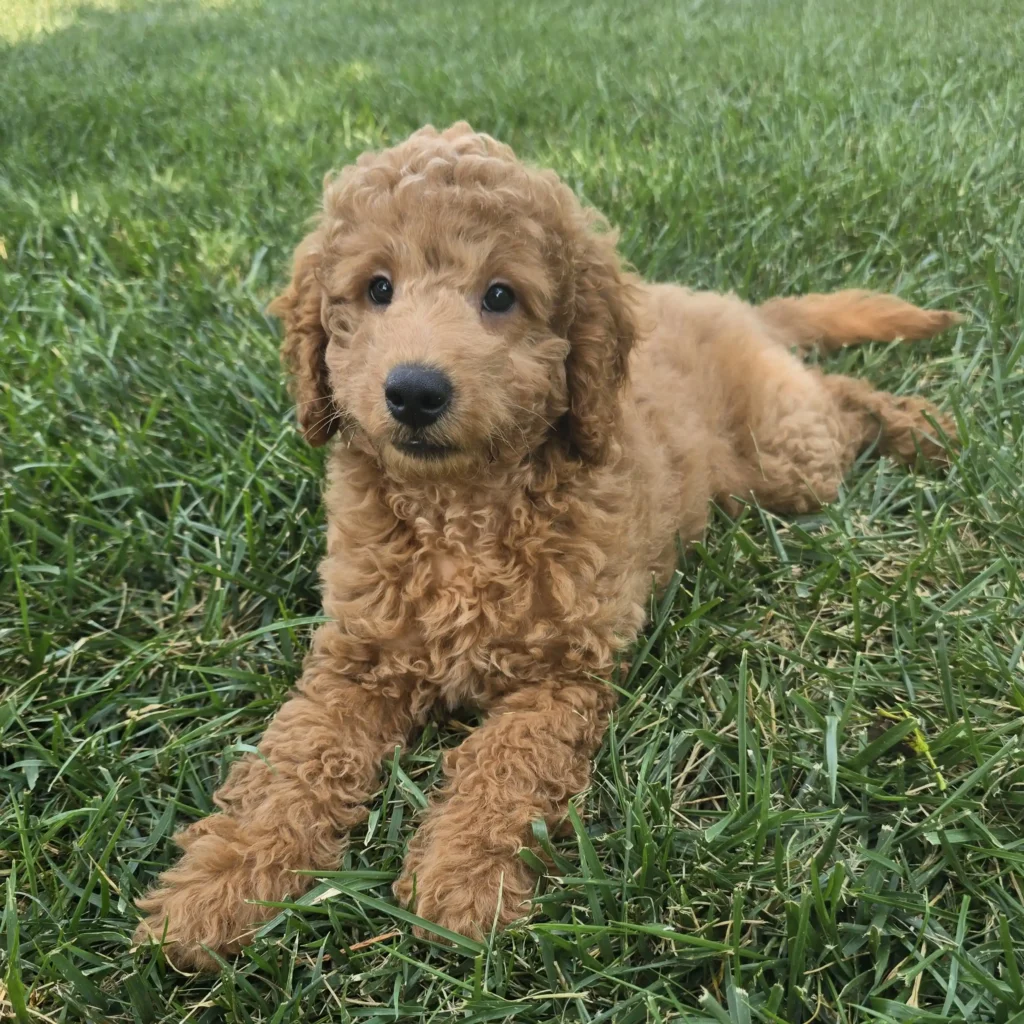
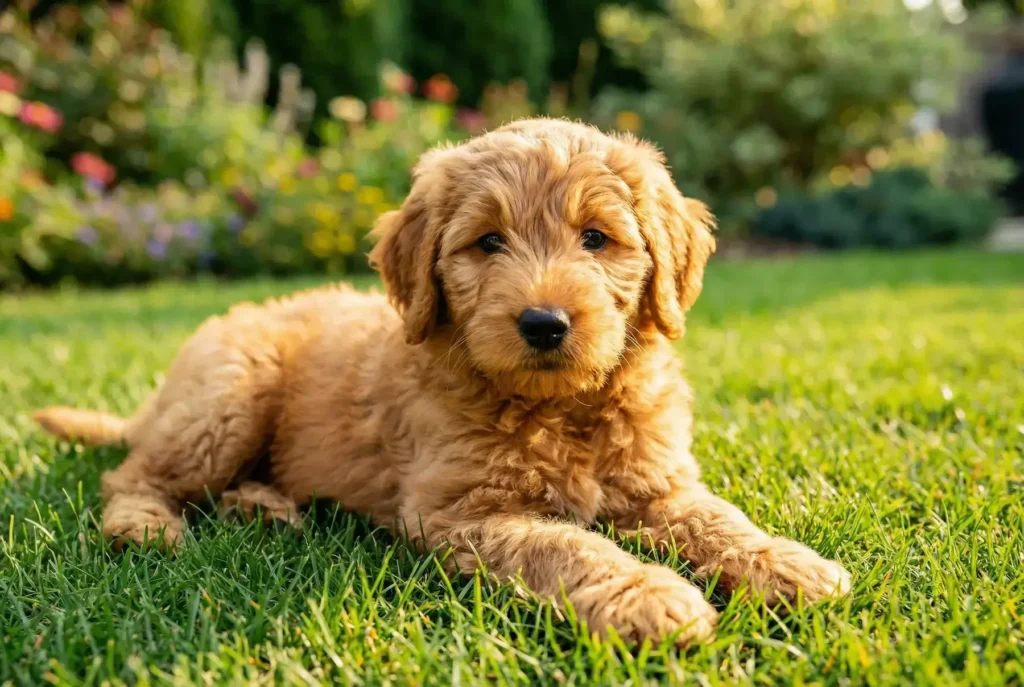
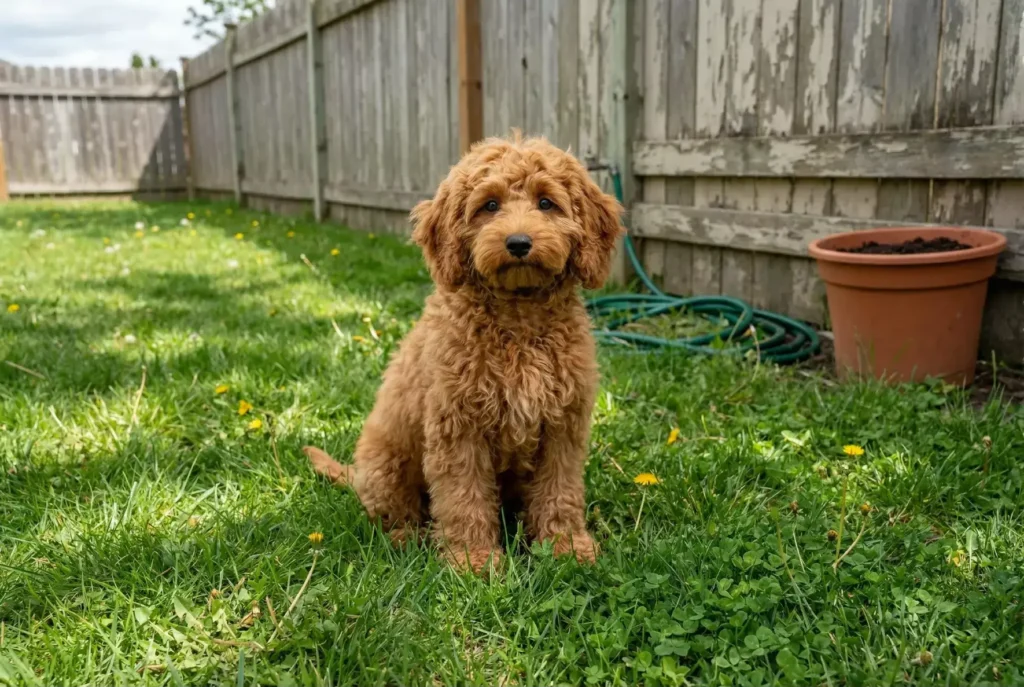
Cavapoo vs Mini Goldendoodle size is the most consistent physical difference between the two breeds. Cavapoos weigh 7 to 25 pounds and stand 9 to 16 inches tall. Mini Goldendoodles weigh 15 to 35 pounds and stand 13 to 20 inches tall. There is overlap at the middle of both ranges, but a Mini Goldendoodle will almost always be the larger dog.
| Characteristic | Cavapoo | Mini Goldendoodle |
| Adult weight | 7–25 lbs | 15–35 lbs |
| Adult height | 9–16 inches | 13–20 inches |
| Coat type | Wavy to curly | Wavy to curly |
| Common colors | Cream, apricot, chestnut, black, parti | Cream, apricot, red, black, chocolate |
| Size predictor | Toy vs. Miniature Poodle parent | Miniature Poodle parent weight |
Size Comparison: Which Breed Is Actually Smaller?
The Cavapoo is consistently smaller, particularly when bred from a Toy Poodle parent rather than a Miniature Poodle. A Toy Poodle × Cavalier cross can produce adults as small as 7 to 10 pounds, genuinely lapdog territory. Mini Goldendoodle full grown size starts at 15 pounds even in the smallest lines. For apartment dwellers or buyers with limited physical strength, this size difference is meaningful. For families with young children, the Mini Goldendoodle’s greater size is actually an advantage. It is robust enough for active play without the injury risk that comes with very small dogs.
Coat Type, Shedding and Allergy Suitability
Both breeds produce low-shedding coats when bred from parents carrying the furnishings gene (RSPO2 variant), as documented by the UC Davis Veterinary Genetics Laboratory. The Mini Goldendoodle and Cavapoo for allergies comparison is essentially equal at the F1B level. Both produce reliably low-shedding coats when one parent is 75% or higher Poodle percentage. The Mini Goldendoodle has a broader generation ladder (F1, F1B, F1BB) that allows buyers to select specifically for the highest coat consistency. For the most allergy-sensitive households, an F1B or F1BB Mini Goldendoodle is the more predictable choice because the generation system is more standardized and better documented across reputable breeders.
Temperament, Energy Level and Day-to-Day Personality
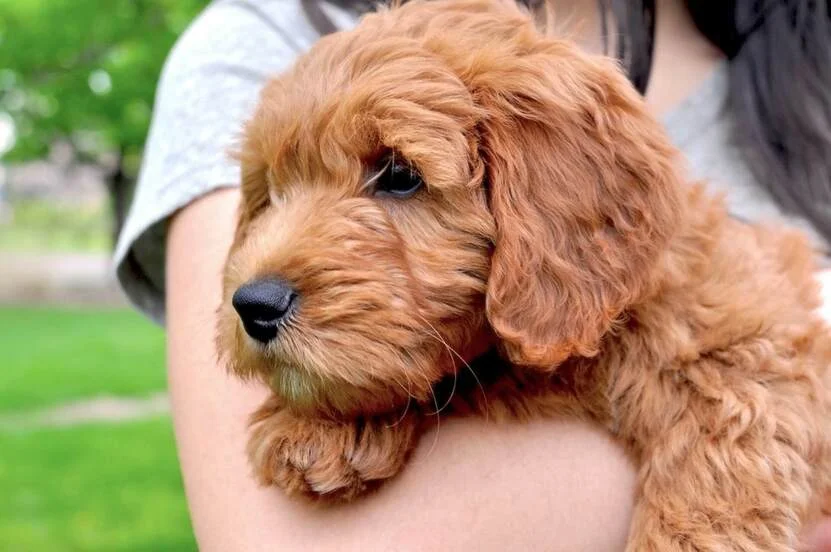
The Mini Goldendoodle and Cavapoo temperament difference is the most important factor for most buyers. Mini Goldendoodles are higher energy, more outgoing, and more independent. Cavapoos are calmer, more attached, and more content with minimal exercise. Neither is better in absolute terms. They suit different households.
Energy Level and Exercise Needs
Mini Goldendoodles need 45 to 60 minutes of daily exercise; Cavapoos are satisfied with 20 to 30 minutes of walking and indoor play. This is the clearest lifestyle filter between the two breeds. An active family with a yard and regular outdoor time will find the Mini Goldendoodle’s energy level a natural fit. A retiree, apartment dweller, or owner with limited mobility will find the Cavapoo far more manageable day to day.
Separation Anxiety, Bonding Style and How Each Breed Handles Being Alone
Both breeds are prone to separation anxiety, but the degree differs. Cavapoos form intense single-person bonds and tend to struggle significantly when left alone. This is a well-documented behavioral pattern in Cavalier lines, noted by the American Veterinary Society of Animal Behavior. Mini Goldendoodles bond closely but adapt better to structured alone time when crate-trained gradually from puppyhood. For working owners who are away 6 to 8 hours a day, the Cavapoo vs Mini Goldendoodle comparison tips clearly toward the Mini Goldendoodle.
Which Breed Is Better With Kids, Other Dogs and Multi-Pet Households?
The Mini Goldendoodle is the stronger choice for families with young children. Its size makes it durable enough for active play, and its Golden Retriever temperament produces consistent patience with toddlers and school-age children. Cavapoos are excellent with gentle, older children, but their small size makes them vulnerable to accidental injury during energetic play. On multi-pet compatibility, Mini Goldendoodles are generally more adaptable. Cavapoos with other pets can show jealousy behaviors, particularly when attention is divided, while Mini Goldendoodles typically integrate well with other dogs and cats when socialized from 8 to 12 weeks.
Health, Lifespan and the Cost of Ownership Over Time
This is where the Cavapoo vs Mini Goldendoodle health comparison matters most, and where most buyer guides fall short by treating the issue in a single sentence.
Cavapoo Health Risks: What Cavalier King Charles Spaniel Genetics Actually Mean
Cavapoos carry a significant inherited health burden from the Cavalier side of their lineage. Mitral valve disease (MVD) affects Cavaliers at a rate that increases with age: approximately 50% of Cavaliers show signs of MVD by age 5 to 7, and nearly 100% are affected by age 10 or older.
Syringomyelia, a neurological condition caused by the Cavalier’s skull structure, affects a substantial proportion of the breed. Studies report MRI-confirmed prevalence ranging from 25% in young dogs to over 70% in dogs aged six years or more, based on a study of 555 Cavaliers published in the Veterinary Record.
These conditions do not disappear in the Cavapoo cross. They are diluted by the Poodle genetics, but a responsible Cavapoo breeder must conduct cardiac screening on both parent dogs annually. Buyers should ask specifically for cardiac clearances dated within the past 12 months, not just a general “vet-checked” declaration. Cardiac monitoring, annual echocardiograms plus potential cardiac medications, can add substantially to lifetime ownership costs for a dog that develops MVD.
Mini Goldendoodle Health Profile and What Reputable Breeders Test For
The Mini Goldendoodle health profile is more straightforward. Primary concerns are hip and elbow dysplasia, progressive retinal atrophy (PRA), and von Willebrand’s disease, all screenable through genetic testing before breeding. The Orthopedic Foundation for Animals (OFA) maintains a public database of hip, elbow, cardiac, and eye clearances verifiable by buyers before purchasing. A reputable Mini Goldendoodle breeder will provide OFA hip and elbow certifications, CAER eye clearances, and a full Embark or equivalent DNA panel for both parents. Mini Goldendoodles live 10 to 15 years; Cavapoos live 12 to 15 years, though cardiac disease can affect quality of life and shorten the higher end of that range in practice.
Price, Grooming Costs and Total Cost of Ownership
Purchase prices for both breeds are comparable: reputable breeders charge $2,000 to $4,000 for either a Cavapoo or Mini Goldendoodle puppy. The ongoing cost differential comes from two sources:
- Grooming. Both breeds require professional grooming every 6 to 8 weeks at $60 to $120 per session. Mini Goldendoodles with tighter F1BB curls require daily brushing; Cavapoos with softer wavy coats require brushing 2 to 3 times per week. Annual grooming costs run $700 to $1,100 for either breed depending on coat type and location.
- Veterinary costs over time. The Cavapoo health cost differential is real. Annual echocardiograms ($300 to $600 each) plus potential cardiac medications can add substantially to lifetime ownership costs for a dog that develops MVD. This does not mean every Cavapoo will develop heart disease, but buyers should budget for the possibility. Mini Goldendoodle veterinary costs from a health-tested breeding program are more predictable: routine wellness, dental care, and the occasional orthopedic concern.
- First-year setup costs. The ASPCA notes that first-year small dog ownership involves significant costs beyond the purchase price across food, veterinary care, supplies, and grooming for both breeds.
Which Breed Is Right for You
No comparison article should end with “you can’t go wrong with either.” Here is the honest framework.
Choose a Mini Goldendoodle:
- You have young children. The Mini Goldendoodle’s size and Golden Retriever temperament make it the more durable, child-safe option for households with toddlers and school-age kids.
- You are active. If your household exercises daily, enjoys outdoor time, and wants a dog that can keep up on hikes and longer walks, the Mini Goldendoodle is built for it.
- You have pet allergies. The generation system for Mini Goldendoodles is more standardized, giving buyers clearer options for the most allergy-friendly coats (F1B, F1BB).
- You work regular hours. Mini Goldendoodles adapt better to structured alone time and are less prone to severe separation distress when trained gradually from puppyhood.
Choose a Cavapoo:
- You want the smallest possible dog. A Toy Poodle × Cavalier Cavapoo at 7 to 12 pounds is genuinely smaller than any Mini Goldendoodle line.
- You have a calmer household. Retirees, remote workers, and owners who are home most of the day will find the Cavapoo’s gentle, low-energy temperament a natural fit.
- You live in an apartment. The Cavapoo’s smaller size and lower exercise needs make it one of the most apartment-friendly small hybrid breeds available.
- You understand and accept the health trade-off. Buyers who find a Cavapoo breeder with documented annual cardiac clearances on both parents and are prepared for the possibility of cardiac costs can own a Cavapoo responsibly and happily.
Conclusion
The choice between a Cavapoo vs Mini Goldendoodle comes down to two honest questions: how active is your household, and how seriously do you take the cardiac health risk in the Cavapoo line? If you have young children, exercise regularly, or need a dog that handles time alone without distress, the Mini Goldendoodle is the more practical choice. If you want the smallest possible dog and are home most of the day, the Cavapoo’s gentle temperament is genuinely hard to beat.
If you have decided the Mini Goldendoodle is the right fit, Love of Puppies breeds health-tested Mini Goldendoodles with early socialization and a written health guarantee.
FAQ
Is a Mini Goldendoodle or Cavapoo better for first-time dog owners?
Both are good choices for first-time owners, but for different reasons. Mini Goldendoodles are easier to train because of their Golden Retriever eagerness to please. Cavapoos are easier to manage physically because of their smaller size and lower energy. If training confidence is a concern, the Mini Goldendoodle’s responsiveness makes it slightly more forgiving for new owners.
Do Cavapoos have more health problems than Mini Goldendoodles?
In terms of inherited cardiac and neurological risk, yes. Mitral valve disease from the Cavalier King Charles Spaniel side is the most significant health concern distinguishing the two breeds. Mini Goldendoodles carry orthopedic and eye disease risks that are screenable before purchase. Both breeds can be healthy with rigorous breeder health testing, but the Cavapoo’s cardiac burden requires ongoing monitoring, not just a one-time pre-purchase screen.
How much does each breed cost?
Both breeds range from $2,000 to $4,000 from reputable breeders. The purchase price is similar; the lifetime cost difference comes from potential cardiac care in the Cavapoo. Grooming costs are comparable: $700 to $1,100 annually for either breed depending on coat type and grooming frequency.
Which breed is better for apartments?
The Cavapoo is generally the better apartment dog due to its smaller size and lower exercise requirements. That said, a Mini Goldendoodle in an apartment is entirely workable provided 45 to 60 minutes of daily outdoor exercise is consistently provided. The bigger challenge in apartment settings for either breed is separation anxiety. Both need structured alone-time training from puppyhood.